Journal
Why Adding Volume Is Not Always the Answer
A visible change in facial contour can invite a quick conclusion. This guide explains why understanding the concern, facial anatomy and individual variation comes before deciding whether treatment, observation or no treatment is appropriate.

What the evidence supports
What is known
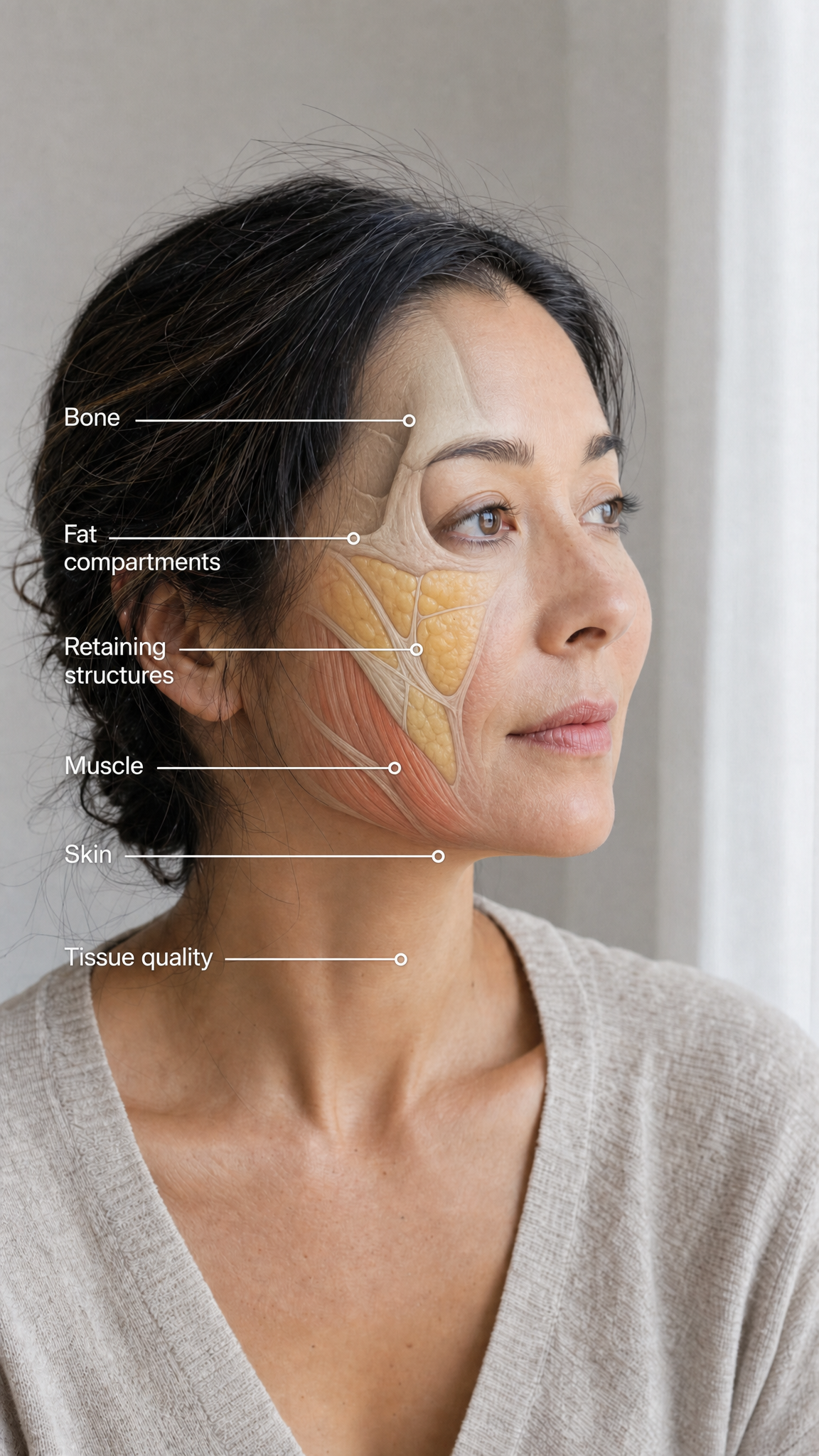
Facial contour reflects bone, fat compartments, retaining structures, muscle, skin and overall tissue quality. Age-related changes can occur across several facial layers.
What varies
Age-related changes can occur across several facial layers, and not every visible change is volume loss that should be replaced. There is no universal amount, treatment category or sequence that is right for every face.
What remains uncertain
Too much or poorly placed filler can distort facial contour or expression, so more volume is not a universal correction. Cosmetic procedures carry risks, and treatment-specific consent remains a separate part of an individual consultation.
Start with the concern
A visible change is not a diagnosis
A change in facial contour can be noticeable, but appearance alone does not show what is happening beneath the surface. It also does not establish that adding volume is the correct response.
The useful starting point is a careful question about the concern and what you would like to understand, rather than an automatic treatment conclusion.
This education is general, not a diagnosis, and an individual assessment remains essential before deciding whether any treatment, or no treatment, is right for you.
- A visible concern does not by itself show that volume needs to be added.
- Assessment begins with the concern, not an assumed answer.
Evidence note: A visible facial concern does not by itself establish that adding volume is the correct response. This education is general, not a diagnosis, and an individual assessment remains essential before deciding whether any treatment, or no treatment, is right for you. sou-277-e02-swift-2021 sou-277-e02-lim-2024 sou-277-e02-nhs-before-cosmetic-procedure sou-277-e02-nhs-choosing-practitioner
Make space for variation
There is no universal volume answer
It is understandable to link a softer contour with volume, yet age-related changes can occur across several facial layers, and not every visible change is volume loss that should be replaced.
There is no universal amount, treatment category or sequence that is right for every face. A visible facial concern does not by itself establish that adding volume is the correct response.
This education is general, not a diagnosis, and an individual assessment remains essential before deciding whether any treatment, or no treatment, is right for you.
- Not every visible change is volume loss that should be replaced.
- There is no universal treatment category or sequence that is right for every face.
Evidence note: Age-related changes can occur across several facial layers, and not every visible change is volume loss that should be replaced. There is no universal amount, treatment category or sequence that is right for every face. sou-277-e02-swift-2021 sou-277-e02-cotofana-2021 sou-277-e02-lim-2024 sou-277-e02-nhs-before-cosmetic-procedure sou-277-e02-nhs-choosing-practitioner

Understand the layers
Facial contour is layered
Facial contour reflects bone, fat compartments, retaining structures, muscle, skin and overall tissue quality. These layers contribute together to what is seen on the surface.
Age-related changes can occur across several facial layers, and not every visible change is volume loss that should be replaced. A change that appears to concern fullness may relate to support, tissue quality, proportion or another anatomical consideration.
The relevant anatomical layer can differ between people, and not every layer changes equally in every person.
- Facial contour is shaped by more than fat or volume.
- Not every visible change is volume loss that should be replaced.
Evidence note: Facial contour reflects bone, fat compartments, retaining structures, muscle, skin and overall tissue quality. Age-related changes can occur across several facial layers, and not every visible change is volume loss that should be replaced. sou-277-e02-swift-2021 sou-277-e02-cotofana-2021
Consider categories, not assumptions
Different concerns may lead to different discussions
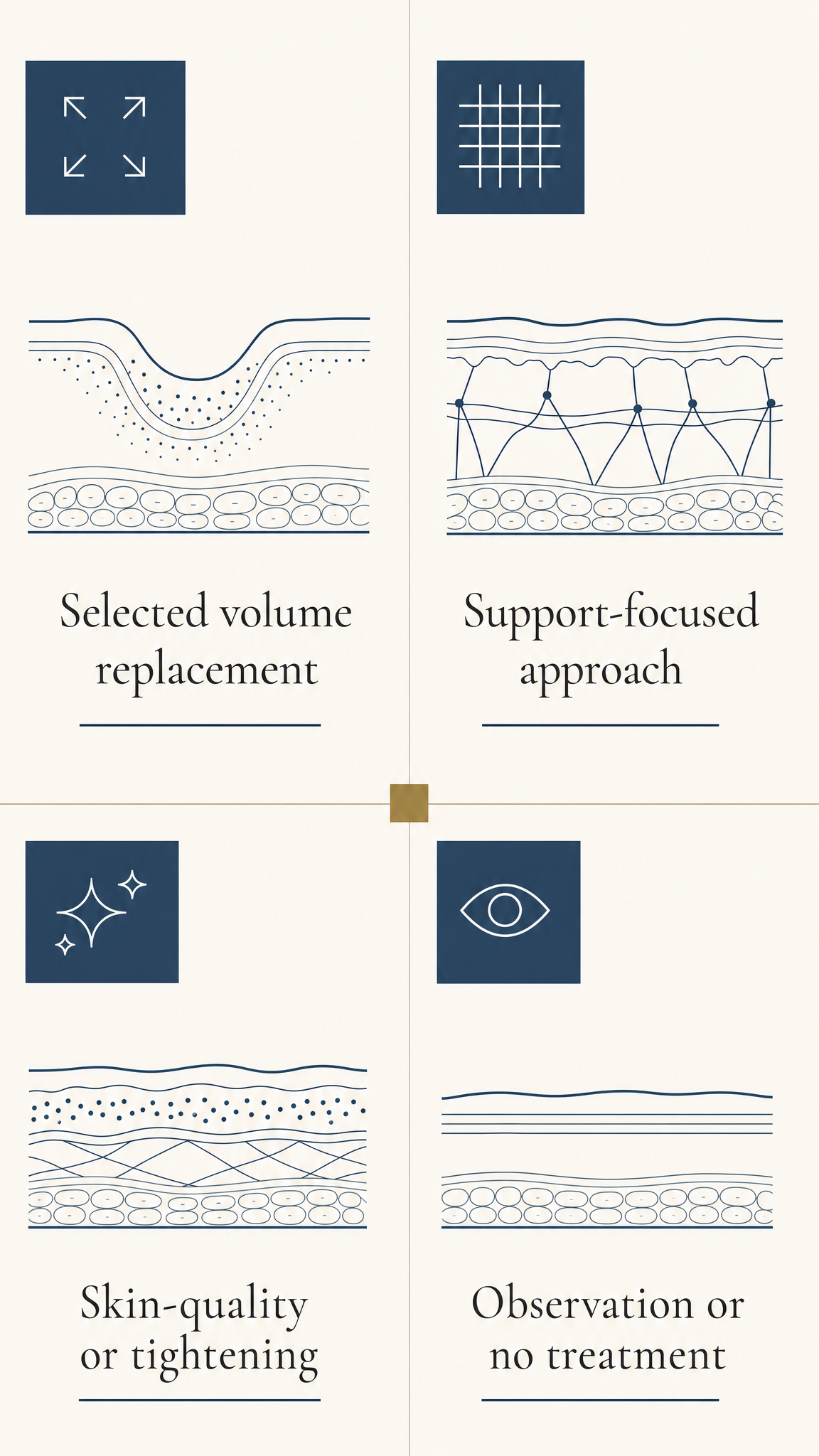
Following assessment, selected volume replacement may be considered when an appropriate tissue deficit and location are identified, but it does not address every cause of facial change. Support-focused treatment may be considered in selected cases, but it is a different decision from simply adding more volume.
Skin-quality or tightening approaches may be more relevant than added volume when assessment identifies tissue quality or laxity as the main concern. For facial contouring choices, treatment, observation, skincare or no treatment may be included when they follow the anatomical layer and concern identified at assessment.
A structural shape concern requires its own assessment pathway. Adding generalised facial volume is not a substitute for that assessment. These are categories for discussion, not a recommendation, product choice, dose or sequence for any individual.
This education is general, not a diagnosis, and an individual assessment remains essential before deciding whether any treatment, or no treatment, is right for you.
- Different categories address different assessment questions.
- For facial contouring choices, observation or no treatment may be included following assessment of the anatomical layer and concern.
Evidence note: Selected volume replacement may be considered when assessment identifies an appropriate tissue deficit and location. Support-focused treatment may be considered in selected cases, and skin-quality or tightening approaches may be more relevant when tissue quality or laxity is the main concern. For facial-contouring choices, treatment, observation, skincare or no treatment may be included following assessment. sou-277-e02-clinic-facial-contouring sou-277-e02-clinic-volume sou-277-e02-clinic-threads sou-277-e02-clinic-tightening sou-277-e02-clinic-rhinoplasty sou-277-e02-cotofana-2021 sou-277-e02-lim-2024 sou-277-e02-nhs-before-cosmetic-procedure sou-277-e02-nhs-choosing-practitioner
Use restraint
More volume is not a universal correction
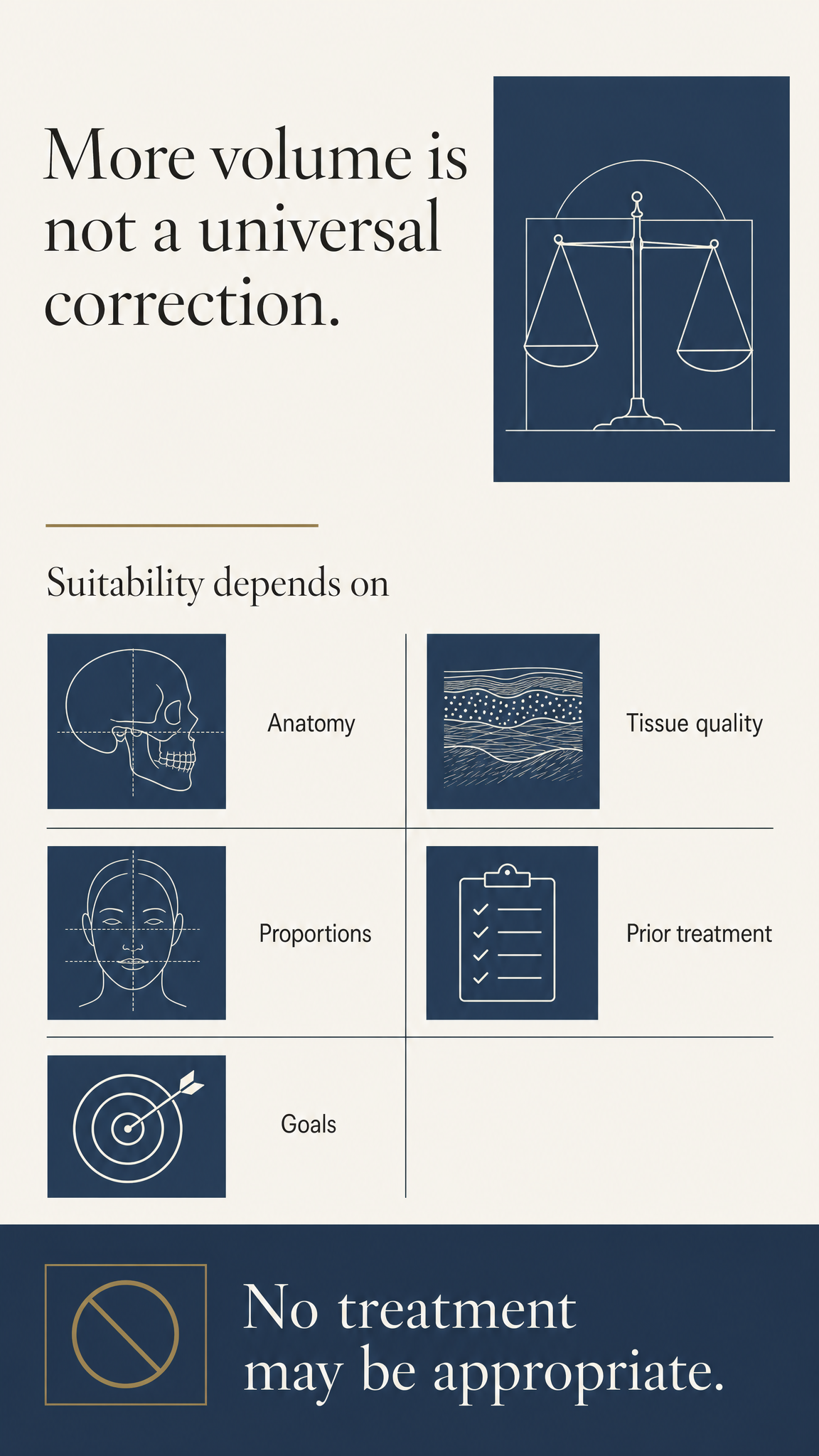
Too much or poorly placed filler can distort facial contour or expression, so more volume is not a universal correction. This does not mean that all filler use causes distortion.
An individual assessment should consider anatomy, tissue quality, proportions, prior treatment, goals and whether no treatment is appropriate. Cosmetic procedures carry risks, and treatment-specific consent remains a separate part of an individual consultation.
This education is general, not a diagnosis, and an individual assessment remains essential before deciding whether any treatment, or no treatment, is right for you.
- For filler, too much or poor placement can distort contour or expression.
- Cosmetic procedures require treatment-specific risk discussion and consent.
- No treatment may be appropriate.
Evidence note: Too much or poorly placed filler can distort facial contour or expression, so more volume is not a universal correction. An individual assessment should consider anatomy, tissue quality, proportions, prior treatment, goals and whether no treatment is appropriate. Cosmetic procedures carry risks, and treatment-specific consent remains a separate part of an individual consultation. sou-277-e02-clinic-facial-contouring sou-277-e02-lim-2024 sou-277-e02-nhs-before-cosmetic-procedure sou-277-e02-nhs-choosing-practitioner
Reach informed judgement
Assessment before an automatic answer
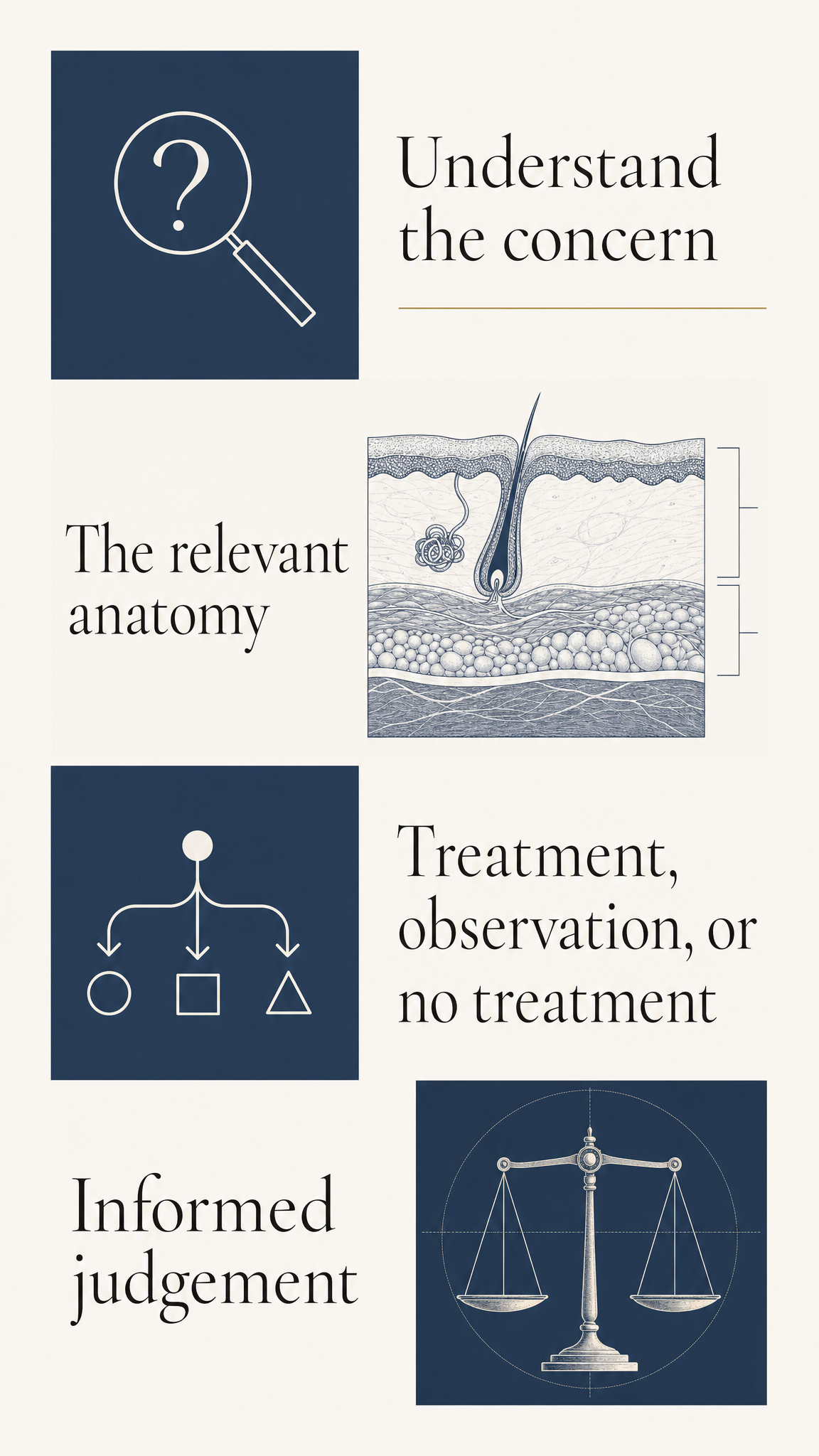
The considered principle is simple: understand the concern and the relevant anatomy before deciding whether treatment, observation, skincare or no treatment is appropriate.
The aim is informed judgement, not an automatic volume-led answer. There is no universal amount, treatment category or sequence that is right for every face.
This education is general, not a diagnosis, and an individual assessment remains essential before deciding whether any treatment, or no treatment, is right for you.
- Understand the concern first.
- Consider the relevant anatomy.
- For facial-contouring choices, treatment, observation, skincare or no treatment may be included following assessment.
Evidence note: Facial-contouring choices should follow the anatomical layer and concern identified at assessment and may include treatment, observation, skincare or no treatment. There is no universal amount, treatment category or sequence that is right for every face. sou-277-e02-clinic-facial-contouring sou-277-e02-cotofana-2021 sou-277-e02-lim-2024 sou-277-e02-swift-2021 sou-277-e02-nhs-before-cosmetic-procedure sou-277-e02-nhs-choosing-practitioner
Sources and references
Evidence and guidance
- Facial Contouring, Clinic: Facial Contouring
- The Facial Aging Process From the Inside Out, Swift et al. 2021
- Treating Aging Changes of Facial Anatomical Layers with Hyaluronic Acid Fillers, Cotofana et al. 2021
- Facial Overfilled Syndrome, Lim 2024
- Before you have a cosmetic procedure, NHS cosmetic procedure guidance
- Choosing who will do your cosmetic procedure, NHS practitioner guidance
- Loss of Volume, Clinic: Loss of Volume
- Dermal Fillers, Clinic: Dermal Fillers
- Threads and Thread-Lifting Procedures, Clinic: Threads and Thread-Lifting Procedures
- Skin Tightening, Clinic: Skin Tightening
- Focus Dual, Clinic: Focus Dual
- Microneedling with Radiofrequency, Clinic: Microneedling with Radiofrequency
- Non-Surgical Rhinoplasty, Clinic: Non-Surgical Rhinoplasty
Treatments that may be relevant
Explore information about treatments that may be discussed after an individual assessment.
-
Facial Contouring
Explore treatment -
Loss of Volume
Explore treatment -
Dermal Fillers
Explore treatment -
Threads and Thread-Lifting Procedures
Explore treatment -
Skin Tightening
Explore treatment -
Focus Dual
Explore treatment -
Microneedling with Radiofrequency
Explore treatment -
Non-Surgical Rhinoplasty
Explore treatment

Ready for a more considered consultation?
A consultation can help determine what is relevant to you.