Journal
Understanding lower-face change before choosing an approach
A softer jawline, folds or reduced definition can be noticeable, but they are not automatically signs that more volume is needed. Lower-face contour reflects several interacting facial layers, and the balance of change differs from person to person.

What the evidence helps clarify
Lower-face change is layered
Skin, fat, muscles, retaining structures and the underlying skeleton all contribute to facial contour. Age-related change can affect several of these layers, with different timing and balance between individuals.
Suitability is individual
Assessment considers anatomy, tissue quality, medical history, prior procedures and priorities. Focused-ultrasound and radiofrequency-microneedling studies use differing devices, settings and outcome measures.
Results are not predictable
Focused-ultrasound benefit may be more limited when laxity is marked. Radiofrequency-microneedling evidence is encouraging, but it does not predict an individual result; serious complications have also been reported.
Lower-face anatomy
Contour reflects more than volume
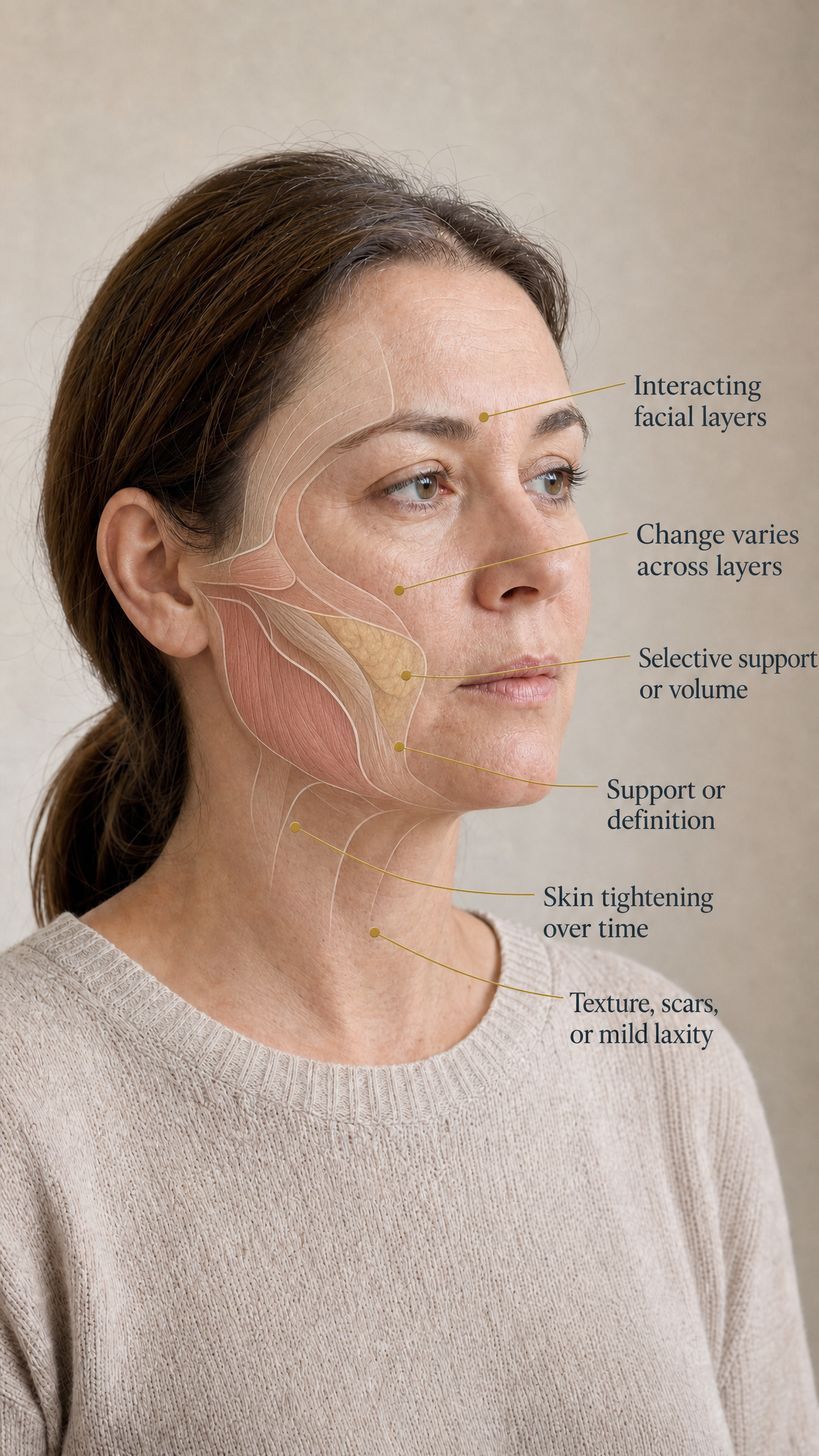
The lower face is made up of interacting layers, including skin, fat, muscles, retaining structures and the underlying skeleton; no single layer alone determines facial contour.
Age-related lower-face change can involve skin thinning or altered quality, changes in fat, muscle tone, support structures and skeletal shape. The balance and timing of these changes vary between individuals. A softer jawline, folds, jowling, hollowness or reduced definition do not automatically mean that more volume is needed. More than one anatomical change may be contributing.
- Visible change is not, by itself, a diagnosis of volume loss.
- Several facial layers can contribute to contour.
Evidence note: Facial ageing is described as a multi-layer process. What is visible at the surface may reflect changes in more than one structure. N1 N2
Individual variation
Why more volume is not the default
A visible lower-face concern may have more than one contributor. Adding volume by default can miss the principal issue and alter proportion without proportionate benefit.
A responsible consultation should consider facial proportions at rest and in movement, skin quality, laxity, tissue distribution, skeletal support, medical history, prior procedures, healing risks and personal priorities. More than one option, observation or no treatment may be appropriate.
Avoid treating every lower-face concern with more volume. A poorly matched or repeated intervention may distort proportions, miss the main anatomical issue, or add risk without proportionate benefit.
- Assessment distinguishes contributing factors before an intervention is considered.
- Observation or no treatment can be appropriate outcomes of assessment.
Evidence note: Lower-face concerns are not automatically volume deficits. Professional guidance supports assessment of the person’s anatomy, history and priorities before deciding whether an intervention is appropriate. N1 N2 N5

Different assessed priorities
Options have distinct intended roles
If assessment identifies a localised loss of support or volume, dermal filler may be discussed to adjust proportion or support a selected area. It is not a universal answer to tissue descent, laxity or poor skin quality.
Thread-lifting may be considered selectively where the assessment is focused on support or definition rather than adding fullness. It should not be presented as equivalent to surgery or as a guaranteed lift.
Focused ultrasound and other skin-tightening approaches may be considered for selected people with mild-to-moderate laxity or skin-quality concerns. They aim to improve tissue tightening rather than replace missing facial volume, and changes develop over time rather than reproducing a surgical result.
Radiofrequency microneedling combines needles with radiofrequency energy at controlled depths. It may be considered where texture, selected acne scars or mild laxity are more prominent than a need for added volume.
- An approach should match the assessed priority, not a single assumed cause.
- Skin-tightening approaches do not replace missing facial volume.
Evidence note: The evidence and clinical guidance distinguish selective support or volume, support or definition, skin tightening, and texture-focused treatment. These are not interchangeable aims. N3 N4 N6 N7 N9 N10 N11 N12 N13
Suitability and uncertainty
Assessment guides a considered plan
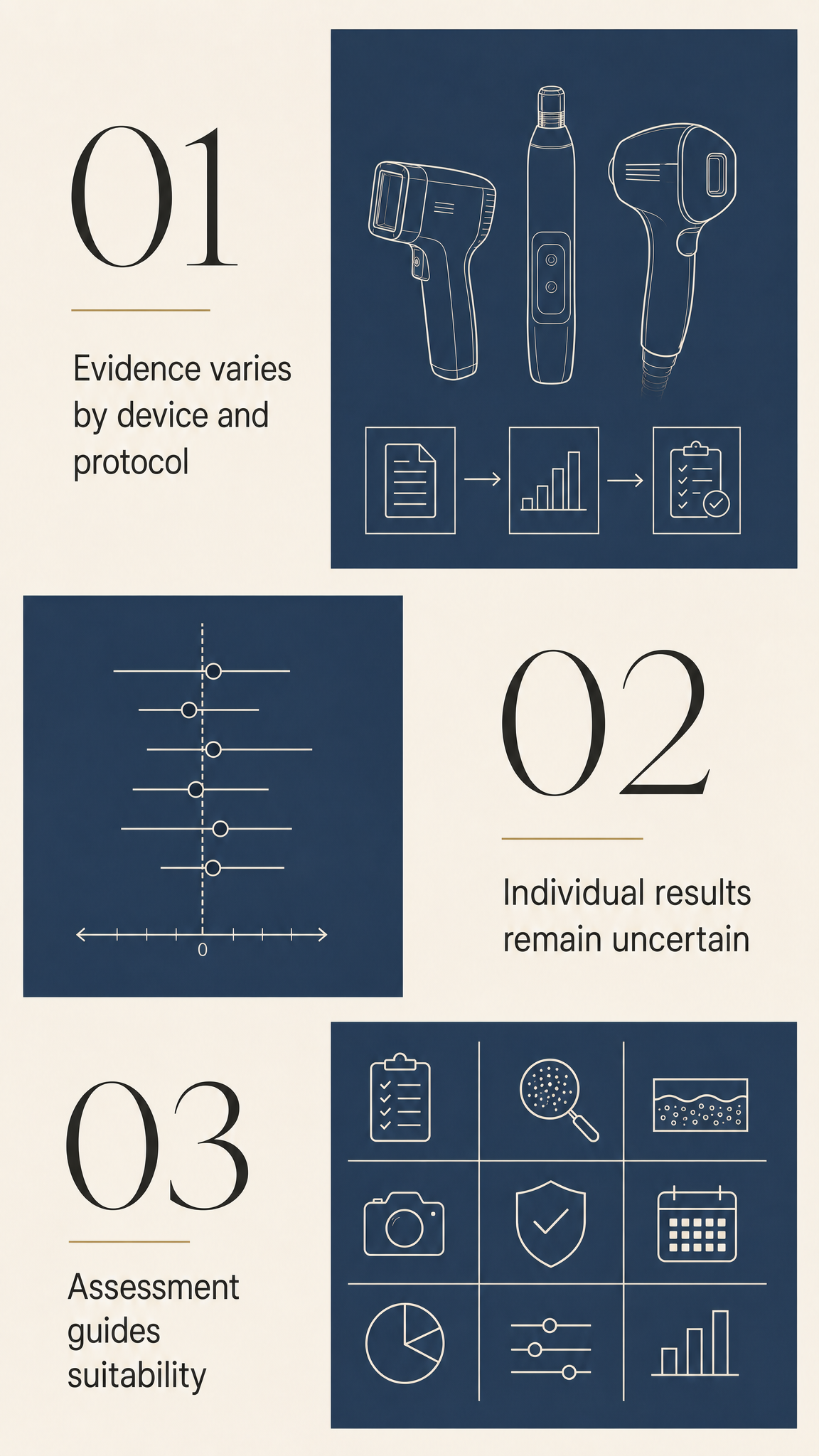
Suitability depends on more than the appearance of one area. A lower-face consultation matches an option to anatomy, tissue quality and priorities; it cannot promise reversal of age-related change. The most appropriate plan may be staged review, skin-focused care or no procedure.
Evidence for focused ultrasound varies by device, energy, protocol and outcome measure. Benefit may be more limited when laxity is marked, so it should be considered only after assessment rather than as a default answer.
Radiofrequency-microneedling evidence is encouraging but does not predict an individual result. Studies use different devices, settings, treatment courses, participants and outcome measures; the recent synthesis also includes manufacturer-affiliated authors.
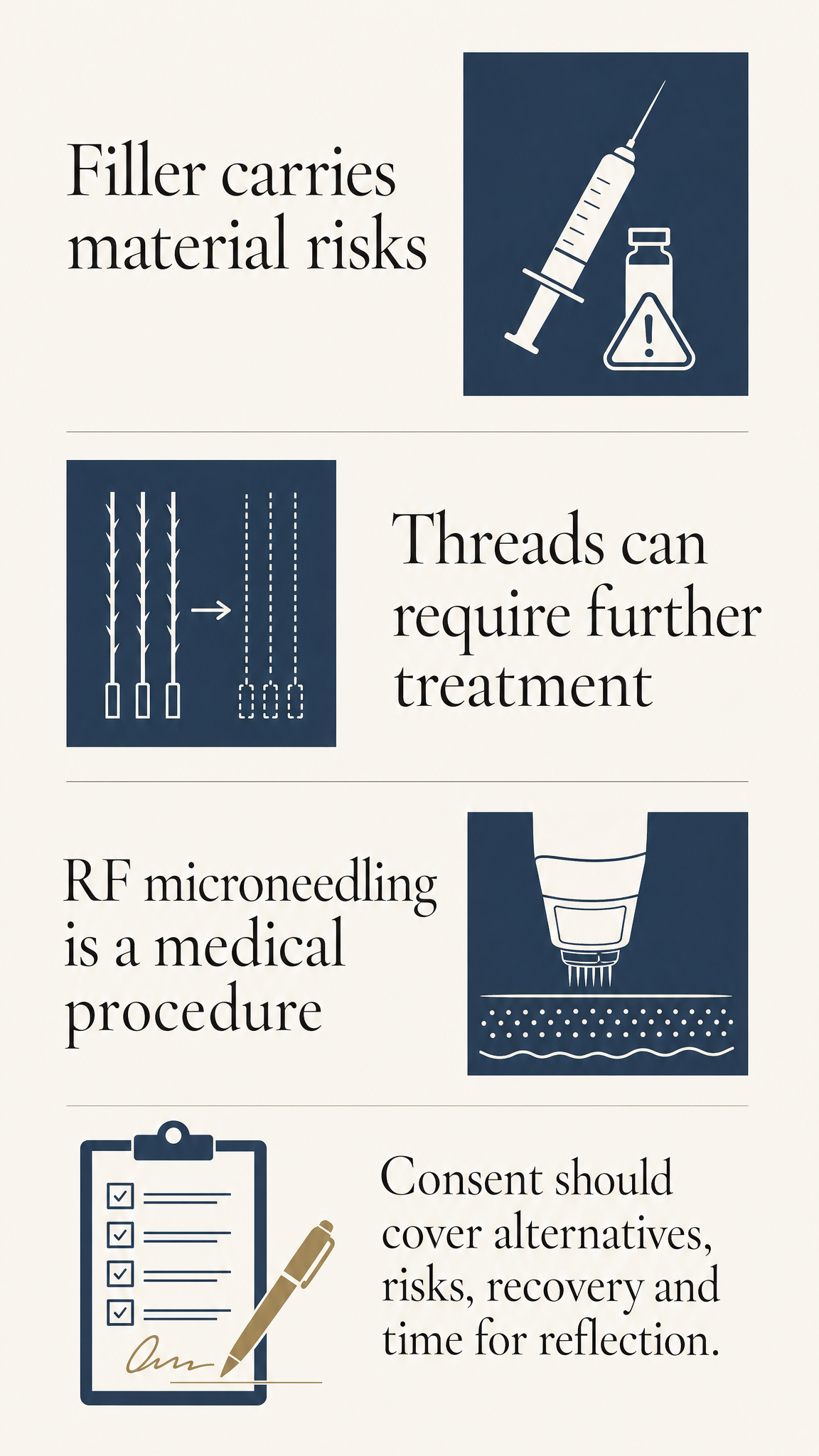
Before a procedure, the clinician should discuss realistic alternatives, including no treatment; expected limitations and uncertainty; recovery; relevant risks; follow-up; costs over time; who will perform it; and how complications can be recognised and managed. The decision must be voluntary and given time for reflection.
- Evidence variability matters when considering device-based approaches.
- A plan may include review, skin-focused care or no procedure.
Evidence note: Assessment-led decision-making includes the limits of available evidence, individual uncertainty and time to consider realistic alternatives. N5 N11 N13
Risks and restraint
Material risks deserve clear discussion
Filler injections can cause temporary swelling, bruising and tenderness. Rare but serious vascular complications can cause tissue damage, so consent should explain warning signs and the clinic’s urgent-response pathway.
Threads can involve swelling, bruising, dimpling, altered sensation, visible or palpable threads, infection, asymmetry or extrusion. Some complications can require further treatment.
Radiofrequency microneedling is a medical procedure. Temporary redness, swelling and discomfort can occur, and serious reported complications include burns, scarring, fat loss, disfigurement and nerve damage.
If an intervention is unlikely to meet the person’s goals or provide overall benefit, it may be appropriate to defer treatment, discuss alternatives or support a second opinion.
- Risks differ between fillers, threads and radiofrequency microneedling.
- Deferral, alternatives or a second opinion may be appropriate.
Evidence note: Each procedure has its own risk profile. Clear information about limitations, complications and appropriate alternatives supports a proportionate decision. N4 N5 N7 N8 N14
A restrained recap
A plan can include no procedure
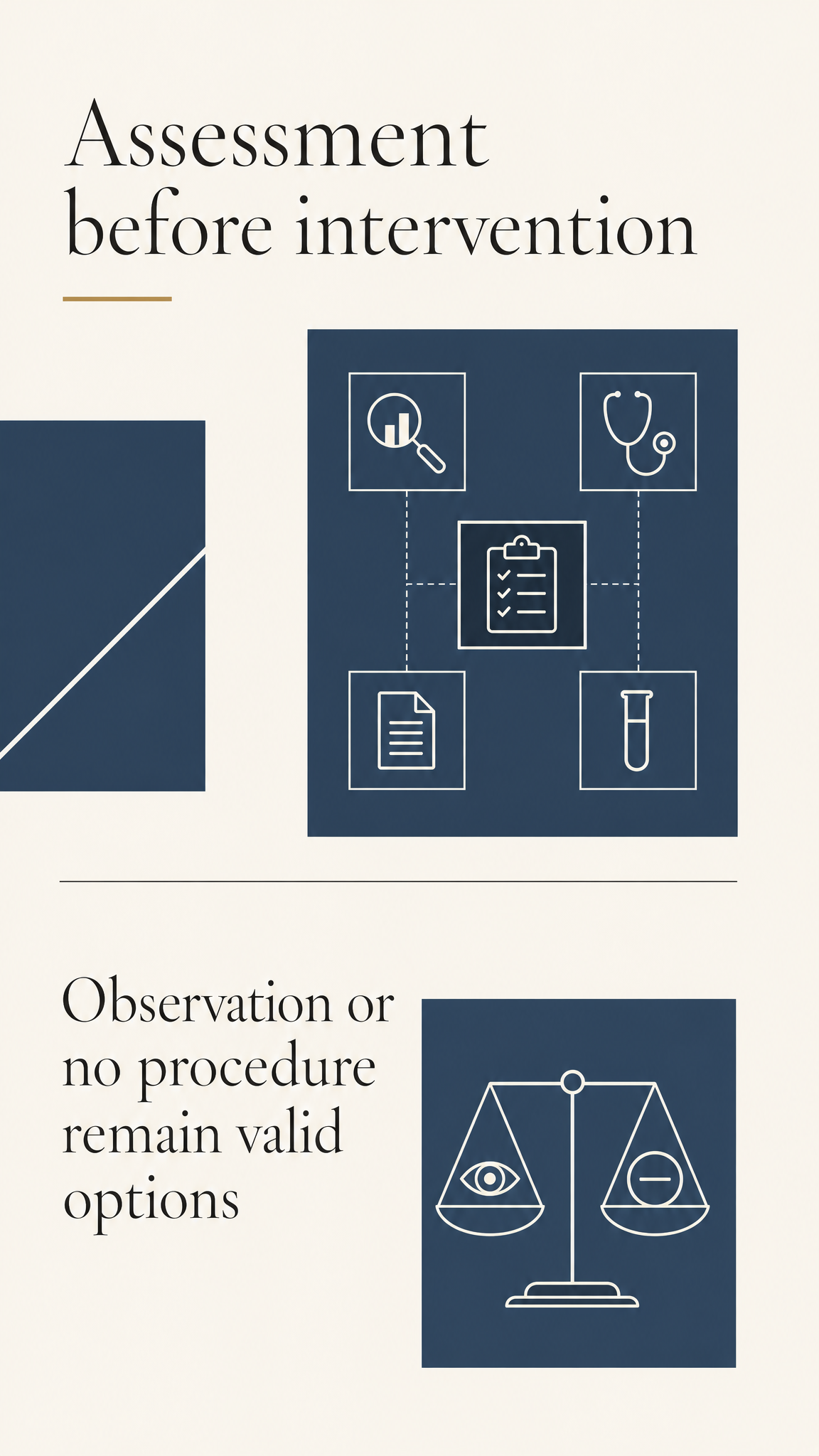
Responsible lower-face care starts with assessment rather than an assumed treatment. It considers proportions, movement, tissue quality, history, healing risks and personal priorities, while recognising that no option can promise reversal of age-related change.
Before a procedure, the clinician should discuss realistic alternatives, including no treatment; expected limitations and uncertainty; recovery; relevant risks; follow-up; costs over time; who will perform it; and how complications can be recognised and managed. The decision must be voluntary and given time for reflection.
The most appropriate plan may be staged review, observation, skin-focused care or no procedure. If an intervention is unlikely to meet the person’s goals or provide overall benefit, it may be appropriate to defer treatment, discuss alternatives or support a second opinion.
- Assessment comes before intervention.
- Observation and no procedure remain valid options.
Evidence note: A responsible plan is guided by assessment, realistic limits and voluntary informed decision-making. Intervention is not always the appropriate next step. N5 N11 N13
Sources and references
Evidence and guidance
- The Anatomy of the Aging Face: A Review, PubMed / Thieme Medical Publishers
- The Facial Aging Process From the “Inside Out”, PubMed
- Dermal Fillers, Dr Souphi
- Guideline for the Management of Hyaluronic Acid Filler-induced Vascular Occlusion, PubMed / Journal of Clinical and Aesthetic Dermatology
- Guidance for doctors who offer cosmetic interventions, General Medical Council
- Threads and Thread-Lifting Procedures, Dr Souphi
- Safety Profile of Thread Lifts on the Face and Neck: An Evidence-Based Systematic Review, PubMed / Dermatologic Surgery
- A Meta-Analysis and Systematic Review of the Incidences of Complications Following Facial Thread-Lifting, PubMed / Aesthetic Plastic Surgery
- Focus Dual, Dr Souphi
- Skin Tightening, Dr Souphi
- A Systematic Review of the Efficacy of Microfocused Ultrasound for Facial Skin Tightening, PubMed / International Journal of Environmental Research and Public Health
- Microneedling with Radiofrequency, Dr Souphi
- Radiofrequency Microneedling for Facial Rejuvenation: A Systematic Review, PubMed / Journal of Cosmetic Dermatology
- Potential Risks with Certain Uses of Radiofrequency (RF) Microneedling – FDA Safety Communication, U.S. Food and Drug Administration
Treatments that may be relevant
Explore information about treatments that may be discussed after an individual assessment.
-
Microneedling with Radiofrequency
Explore treatment -
Threads and Thread-Lifting Procedures
Explore treatment -
Dermal Fillers
Explore treatment -
Focus Dual
Explore treatment

Ready for a more considered consultation?
A consultation can help determine what is relevant to you.