Journal
What Natural-Looking Means in Facial Contouring
Natural-looking is personal, not a fixed facial template. Facial layers, changing proportions and the limits of different options all matter when facial contour is discussed.

What the evidence supports
Facial change is layered
Skin, fat, muscles, supporting structures and bone all contribute to facial contour. Change over time can affect these layers differently, and the balance varies between individuals.
Some effects and durations vary
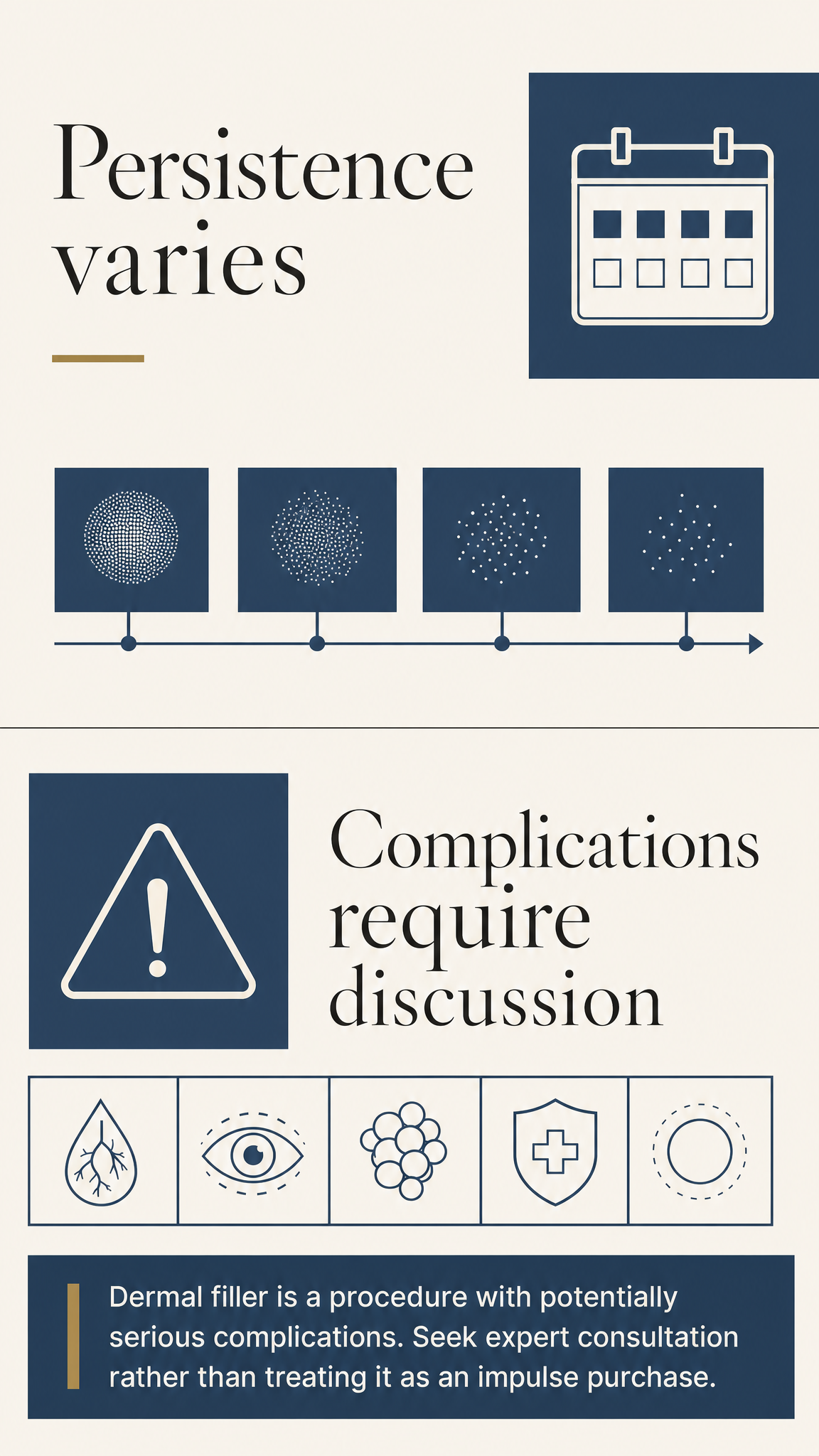
How long hyaluronic-acid filler persists varies by product, facial area, tissue movement and the individual. Thread-lift satisfaction may decline over time.
Long-term thread outcomes remain uncertain
Research on thread lifting does not establish it as a durable substitute for surgery. Effectiveness and long-term satisfaction remain uncertain and need further study.
Starting with individuality
Natural-looking is not one look
A natural-looking result is not one facial template. It should be discussed in relation to your own proportions, features and movement, rather than treating one area in isolation.
The face is layered: skin, fat, muscles, retaining structures and bone all contribute to contour. A hollow, fold or softening is not automatically a problem of missing volume alone.
Facial change over time can involve skin, fat compartments, muscles, supporting structures and bone. The balance of these changes differs from person to person, so a similar-looking concern may call for a different conversation.
- Proportions, features and movement matter.
- A visible change can have more than one contributing layer.
Evidence note: Evidence describes facial form and ageing as layered and individual, rather than explained by one feature or one cause. A01 A02
Looking beyond volume
A hollow does not explain itself
Loss of volume is one possible contributor to facial change, but it should be assessed in context. Adding volume where it is not the main issue can make proportions look less balanced rather than more natural.
A photograph, trend or single feature cannot determine the right option. Whether contouring, filler, threads, non-surgical rhinoplasty or volume restoration is appropriate depends on examination, anatomy, medical history, previous procedures and the trade-offs you are prepared to accept.
- Volume loss is one possible contributor, not a diagnosis.
- A single image cannot establish suitability.
Evidence note: Facial change is multifactorial. Assessment considers the person, not only the feature shown in a photograph. A01 A02 A04 A08 A11 A07 A13

Different roles, defined limits
Options do different things
At this clinic, facial contouring is a consultation-led category that may involve fillers, threads and other approaches. A responsible discussion starts by identifying whether the visible concern is proportion, local volume, tissue position, movement, skin quality, or a mixture of these.
Hyaluronic-acid filler can add soft-tissue volume or alter local contour. It may be considered where volume or proportion is relevant, but it does not correct every type of laxity, texture concern or facial change.
Thread-lifting may be discussed where modest support or repositioning is being considered rather than adding fullness alone. It is not the same as a surgical facelift, and it should not be presented as a durable substitute for surgery.
Non-surgical rhinoplasty uses injectable filler to camouflage or refine selected contour irregularities. It adds material: it does not make the nose smaller, correct internal breathing problems, or provide the full range of structural changes possible with surgical rhinoplasty.
- Filler concerns volume and local contour.
- Threads are not a surgical facelift.
- Non-surgical rhinoplasty adds material rather than reducing the nose.
Evidence note: These options have different mechanisms and boundaries. Their suitability cannot be assumed from a concern alone. A02 A03 A04 A08 A09 A11 A12

Assessment before assumptions
Suitability is individual
Suitability requires an individual consultation. It should cover the planned area and goal, medical history, previous procedures or filler, relevant current inflammation or infection, medicines, and any altered anatomy from surgery or scarring.
A photograph, trend or single feature cannot determine the right option. Whether contouring, filler, threads, non-surgical rhinoplasty or volume restoration is appropriate depends on examination, anatomy, medical history, previous procedures and the trade-offs you are prepared to accept.
For a UK public-facing asset, describe dermal filler as a procedure with potentially serious complications and direct readers to an expert consultation rather than presenting treatment as an impulse purchase. Prescription-only medicines must not be publicly advertised.
- Assessment includes goals, anatomy, history and previous procedures.
- Options involve trade-offs as well as possible benefits.
Evidence note: Individual assessment and informed discussion are central to deciding whether any option is appropriate. A02 A04 A06 A07 A08 A11

Reasons for restraint
Risks and limits need time
“Natural-looking” must not imply that filler is invisible, permanent, risk-free or automatically the right answer. How long material persists and how a result appears vary by product, facial area, tissue movement and the individual.
Filler can cause swelling, bruising, inflammatory reactions, lumps and infection. Rarely, it can compromise blood flow and lead to serious tissue or visual injury. Warning symptoms, emergency arrangements and follow-up should be discussed before treatment.
Threads have recovery and complication considerations. Swelling, bruising, dimpling, asymmetry, altered sensation, visible or palpable threads, infection and extrusion need an unhurried consent discussion.
The nose is a high-stakes area for filler. Serious vascular events, including vessel occlusion, skin necrosis and visual loss, have been reported. Any consideration of this option requires individual assessment and explicit discussion of urgent complication pathways.
- Filler persistence varies.
- Filler and threads have distinct complication considerations.
- Nasal filler requires explicit discussion of urgent complication pathways.
Evidence note: Risk discussion should be specific to the option and area being considered, including warning symptoms, emergency arrangements and follow-up where relevant. A05 A06 A07 A09 A10 A12
A considered conclusion
Individual, layered, assessment-led
Natural-looking is individual and layered. Facial change can involve skin, fat compartments, muscles, supporting structures and bone, with a different balance from one person to another.
Loss of volume is one possible contributor to facial change, but it should be assessed in context. Adding volume where it is not the main issue can make proportions look less balanced rather than more natural.
A photograph, trend or single feature cannot determine the right option. The conversation should consider anatomy, priorities, medical history, previous procedures, trade-offs, options and their limits.
Arrange a consultation to discuss your anatomy, priorities, options and their limits.
- Natural-looking is not a universal template.
- Volume is not the only explanation for facial change.
- Options should be discussed with their limits.
Evidence note: A layered assessment helps keep the discussion focused on individual anatomy, realistic boundaries and informed trade-offs. A01 A02 A04 A07 A08 A11 A13

Sources and references
Evidence and guidance
- The Anatomy of the Aging Face: A Review, PubMed / Facial Plastic Surgery
- The Science and Theory behind Facial Aging, Plastic and Reconstructive Surgery Global Open / PubMed Central
- Facial Contouring, Dr Souphi Aesthetics and Wellbeing
- Dermal Fillers, Dr Souphi Aesthetics and Wellbeing
- Clinical Durability of Hyaluronic Acid-Based Dermal Fillers for Facial Application: A Systematic Review, PubMed / Aesthetic Plastic Surgery
- Guideline for the Management of Hyaluronic Acid Filler-induced Vascular Occlusion, PubMed / Journal of Clinical and Aesthetic Dermatology
- Choosing who will do your cosmetic procedure, NHS
- Threads and Thread-Lifting Procedures, Dr Souphi Aesthetics and Wellbeing
- A Meta-Analysis and Systematic Review of the Incidences of Complications Following Facial Thread-Lifting, PubMed / Aesthetic Plastic Surgery
- Safety Profile of Thread Lifts on the Face and Neck: An Evidence-Based Systematic Review, PubMed / Dermatologic Surgery
- Non-Surgical Rhinoplasty, Dr Souphi Aesthetics and Wellbeing
- Complications Secondary to Nonsurgical Rhinoplasty: A Systematic Review and Meta-analysis, PubMed / Aesthetic Surgery Journal
- Loss of Volume, Dr Souphi Aesthetics and Wellbeing
Treatments that may be relevant
Explore information about treatments that may be discussed after an individual assessment.
-
Loss of Volume
Explore treatment -
Facial Contouring
Explore treatment -
Dermal Fillers
Explore treatment -
Threads and Thread-Lifting Procedures
Explore treatment -
Non-Surgical Rhinoplasty
Explore treatment

Ready for a more considered consultation?
A consultation can help determine what is relevant to you.