Journal
When no treatment may be the right answer
A line, shadow or contour change can involve more than one facial layer. Understanding the limits of each option can make waiting, further assessment or no treatment a considered outcome.

What the evidence supports
Facial change has more than one contributor
Skin, fat, supporting tissues and bone can all change over time. A visible line, shadow or contour change does not automatically identify one problem or make treatment necessary.
Skin support has a defined role
Daily sun protection reduces UV exposure, and topical retinoid evidence supports improvement in signs of photodamage over months. Product choice, tolerability and suitability need individual assessment. Skincare does not restore structural facial volume or reposition descended tissue.
Service descriptions do not determine an individual outcome
The clinic describes prescribed skincare as skin support, filler as a selective structural option, threads as selective support for lift and definition, and wrinkle-reduction injections as addressing movement-related lines. These descriptions do not establish that any option is suitable, safe or likely to achieve a particular outcome for an individual.
Recognising change
One visible feature can have several contributors
A line, shadow or change in contour can reflect more than one layer of the face. Skin, fat, supporting tissues and bone all change over time.
That means one visible feature does not automatically identify one problem, or point to one response. It also does not make treatment necessary. Beginning with this uncertainty can help keep the question focused on what is actually contributing, rather than on a single appearance-led assumption.
- A visible change is not a diagnosis.
- Facial change can involve skin, fat, supporting tissues and bone.
- Treatment is not automatically necessary.
Evidence note: Facial ageing is multifactorial. A visible feature may have more than one anatomical contributor, so it does not by itself establish a treatment need. E5
A valid outcome
Waiting can be a considered decision
A consultation may properly conclude that waiting, gathering more information, allowing time for reflection or choosing no treatment is appropriate. This can be the clinical outcome when an intervention is unlikely to meet a person’s goal or provide overall benefit, or when more assessment, time or support is needed. Deferring treatment is not a failed consultation.
A cosmetic consultation should establish the person’s concerns, hoped-for outcome and relevant medical history; discuss alternatives, including doing nothing; explain limitations and material risks; and allow time and information for a voluntary, informed decision. The clinician undertaking or supervising the procedure is responsible for consent.
- No treatment can be an appropriate clinical outcome.
- More information, time or support may be needed before a decision.
- A voluntary, informed decision includes alternatives, including doing nothing.
Evidence note: Professional guidance supports declining or deferring an intervention when it is unlikely to provide the desired outcome or overall benefit, while ensuring informed, voluntary decision-making. E14

Different layers, different limits
Options are not interchangeable
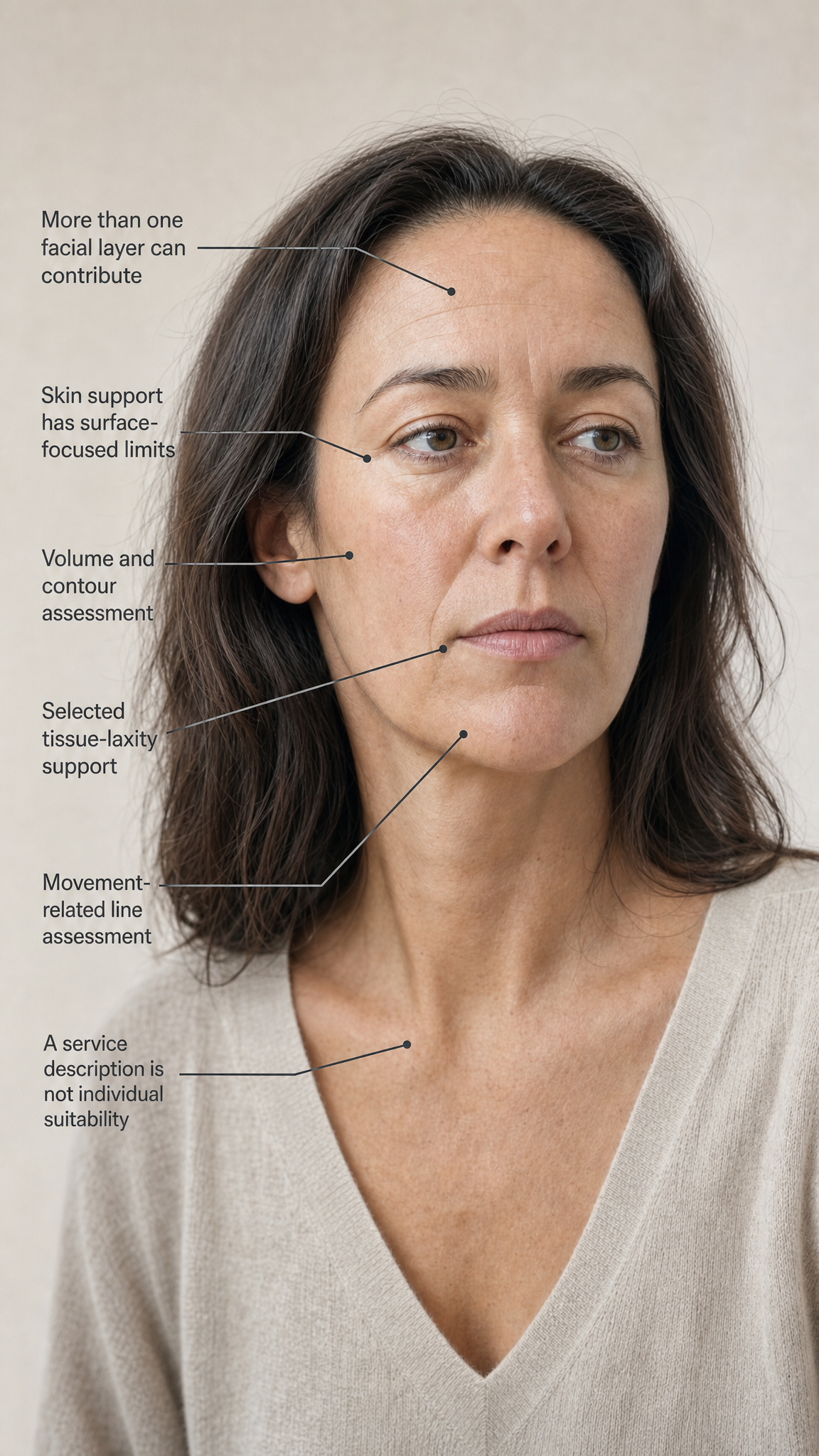
Loss of volume, tissue laxity and skin-surface change are not interchangeable. A volume-focused approach cannot be assumed to lift descended tissue or improve skin texture, and a lifting approach cannot be assumed to replace missing volume.
For a skin-led concern, a prescribed skincare plan may be a proportionate first step. Daily sun protection reduces UV exposure, and some topical retinoid evidence supports improvement in signs of photodamage over months. Product choice, tolerability and suitability still need individual assessment.
Skincare can support skin-surface concerns such as photodamage, uneven tone or dryness, but it does not restore structural facial volume or reposition descended tissue. Its usefulness depends on the concern, active ingredients, adherence and skin tolerance.
- Skin-surface change, volume loss and tissue laxity are distinct considerations.
- Skincare has a surface-focused role.
- Skincare does not restore structural volume or reposition descended tissue.
Evidence note: Evidence for topical retinoids concerns signs of photodamage over months. It does not establish replacement of deeper structural volume or repositioning of descended tissue. E5 E6 AX3 E17
Assessment questions
The question comes before the option
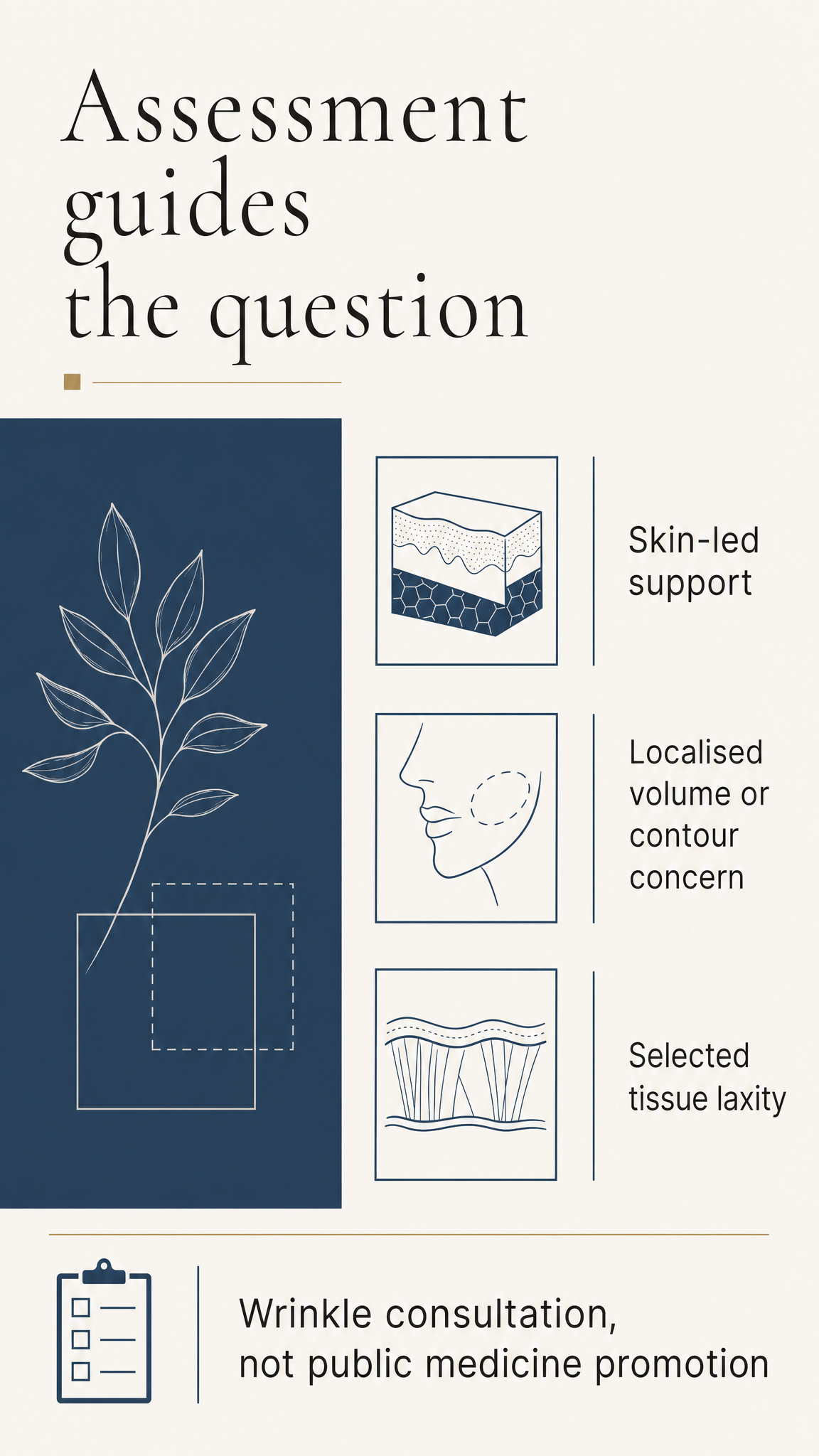
Dermal filler is a volume and contour approach. It may be considered for a localised structural or proportional concern identified in assessment, but it is not an automatic answer to every fold, shadow, laxity concern or request for a lift.
Threads may be considered to support selected areas where tissue laxity is part of the assessment. They are not equivalent to a surgical facelift, and the available evidence does not support presenting them as a universal or permanent solution.
For lines and wrinkles, assessment may consider whether muscle movement is contributing. A prescription-only muscle-relaxing injectable may reduce movement-related lines in suitable patients, but it does not replace volume, correct every resting line or address all causes of skin-texture change.
Public-facing material should promote a consultation for wrinkles rather than a prescription-only botulinum toxin treatment. If a treatment option is discussed on a website, it must be factual, balanced, non-promotional and available only through an appropriately consultation-led journey.
- Filler is not an automatic answer to every fold, shadow, laxity concern or request for a lift.
- Threads are not equivalent to a surgical facelift or a universal or permanent solution.
- Movement-related lines are assessed differently from volume or skin-texture concerns.
Evidence note: Assessment distinguishes localised volume or contour concerns, selected tissue laxity and movement-related lines. None of these categories makes an option automatically suitable. E5 AX6 E19 AX9 E20 AX12
Limits and material risks
Restraint includes discussing risk clearly
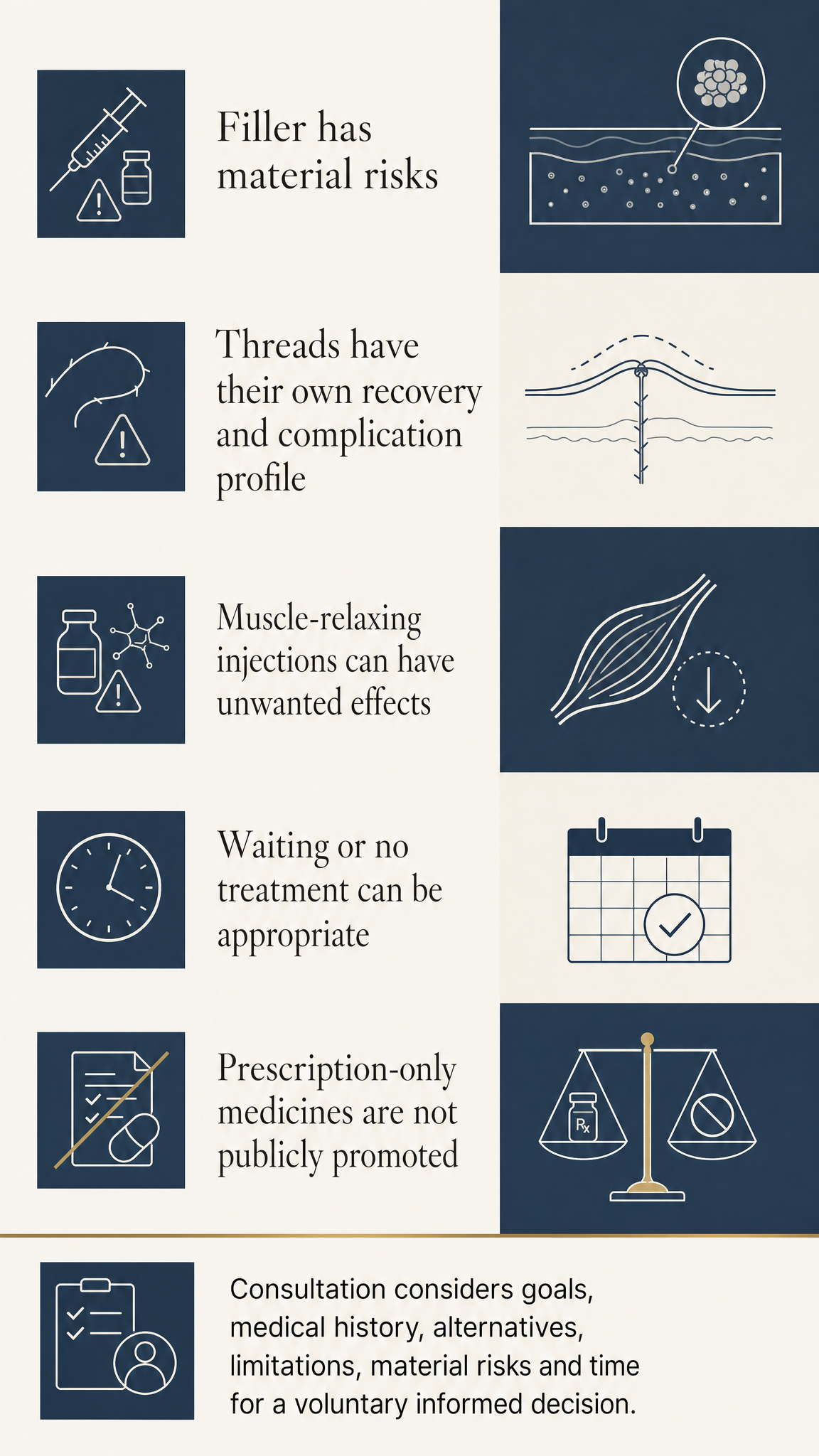
Filler involves injections. Swelling, bruising, tenderness and other local reactions can occur. More serious complications, including vascular complications and potentially persistent injury, are uncommon but clinically important and should be discussed before a decision is made.
Thread procedures have their own recovery and complication profile. This can include swelling, bruising, discomfort, dimpling, altered sensation, thread visibility or palpability, infection, migration and extrusion.
Muscle-relaxing injectable treatment can have unwanted effects, including local reactions, headache, asymmetry, heaviness and temporary eyelid or brow droop, depending on the area and technique.
A cosmetic consultation should establish the person’s concerns, hoped-for outcome and relevant medical history; discuss alternatives, including doing nothing; explain limitations and material risks; and allow time and information for a voluntary, informed decision. The clinician undertaking or supervising the procedure is responsible for consent.
- Filler complications can include uncommon but clinically important vascular complications and potentially persistent injury.
- Threads have a distinct recovery and complication profile.
- Muscle-relaxing injectable treatment has area- and technique-dependent unwanted effects.
Evidence note: Each procedure has its own risk profile. Material risks, limitations, alternatives and time for a voluntary decision are part of consultation. AX7 E19 AX9 E20 E14
Informed perspective
Care, waiting or no treatment
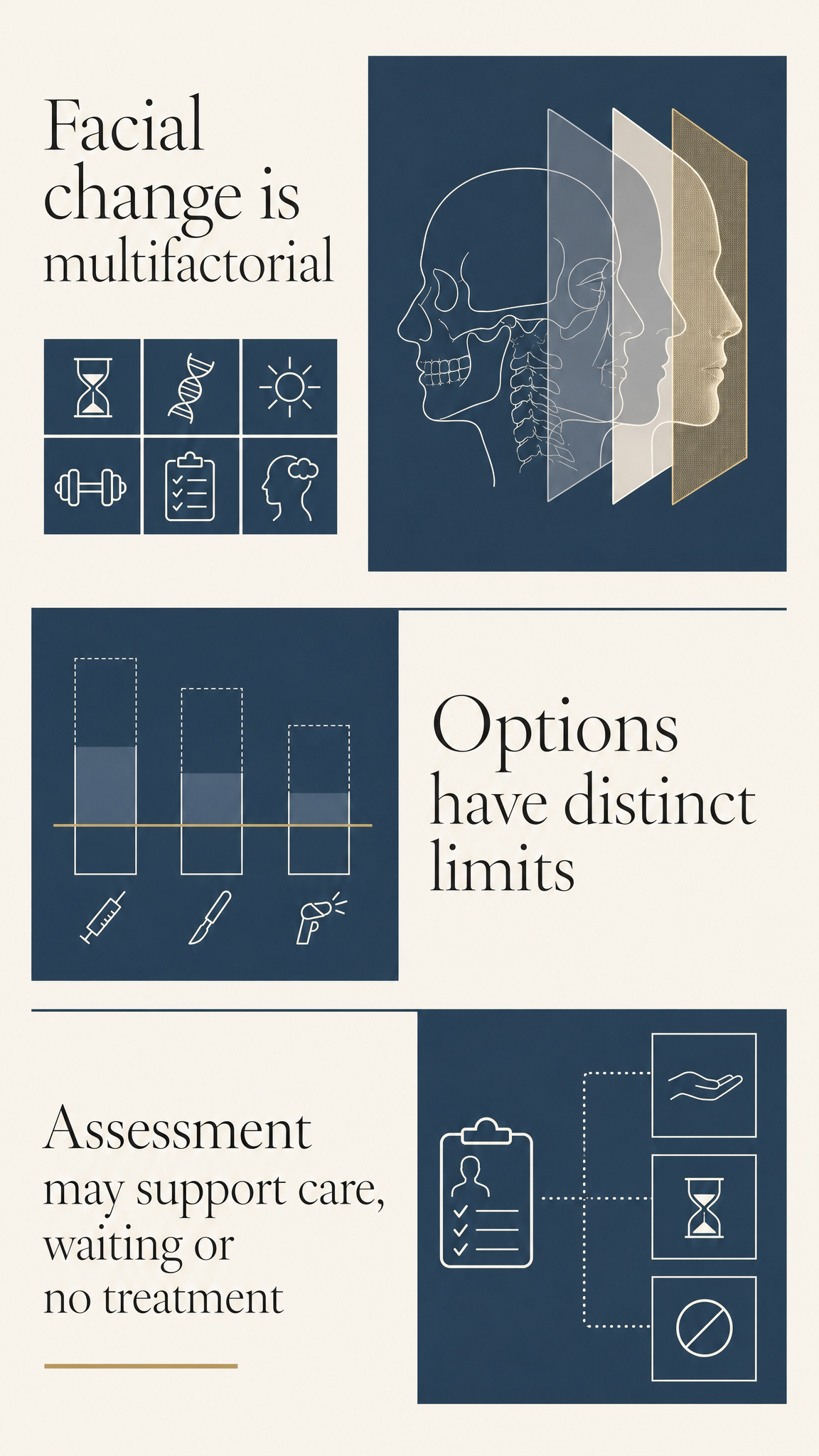
Facial change is multifactorial, and options are not interchangeable. Skin-surface change, volume loss and tissue laxity may each raise different questions in assessment.
No treatment, or a decision to wait, can be the appropriate clinical outcome when an intervention is unlikely to meet the person’s goal or provide overall benefit, or when more information, assessment, time or support is needed. Deferring treatment is not a failed consultation.
An informed assessment may therefore lead to selective care, waiting or no treatment. The value of that assessment is not in forcing a procedure, but in making the limits, uncertainties and alternatives clear enough for a voluntary decision.
- Facial change is multifactorial.
- Options have distinct limits.
- Waiting or no treatment may be appropriate.
Evidence note: A multifactorial understanding of facial change supports assessment-led decisions, including the possibility that waiting or no treatment is the appropriate outcome. E5 E14
Sources and references
Evidence and guidance
- The Science and Theory behind Facial Aging, Plastic and Reconstructive Surgery Global Open / PMC
- Topical tretinoin for treating photoaging: A systematic review of randomized controlled trials, Journal of Women’s Dermatology / PMC
- Cosmetic interventions: Communication, partnership and teamwork, General Medical Council
- Medical Grade Skincare, Dr Souphi Aesthetics & Wellbeing
- Dermal Fillers, Dr Souphi Aesthetics & Wellbeing
- Threads and Thread-Lifting Procedures, Dr Souphi Aesthetics & Wellbeing
- Wrinkle Reduction Injections, Dr Souphi Aesthetics & Wellbeing
- Tretinoin for Photodamaged Facial Skin: Systematic Review and Meta-Analysis of Randomized Controlled Trials, Dermatology Practical & Conceptual / PMC
- Adverse Events in Nonsurgical Facial Aesthetic Procedures: A Systematic Review and Meta-Analysis, Journal of Cosmetic Dermatology / PMC
- A Meta-Analysis and Systematic Review of the Incidences of Complications Following Facial Thread-Lifting, Aesthetic Plastic Surgery / PubMed
- Cosmetic Botulinum Toxin A Injections to the Upper Face: A Systematic Review and Meta-Analysis of Clinical Studies, Journal of Cosmetic Dermatology / PMC
- Botox and non-surgical cosmetic interventions, Advertising Standards Authority / Committee of Advertising Practice
Treatments that may be relevant
Explore information about treatments that may be discussed after an individual assessment.
-
Dermal Fillers
Explore treatment -
Threads and Thread-Lifting Procedures
Explore treatment -
Wrinkle Reduction Injections
Explore treatment -
Medical Grade Skincare
Explore treatment

Ready for a more considered consultation?
A consultation can help determine what is relevant to you.