Journal
Why the lower face can lose definition
A softer jawline is not one diagnosis or one anatomical problem. Lower-face definition reflects structure, soft tissue, movement and skin quality. Understanding these overlapping contributors helps set realistic expectations for an individual assessment.

What the evidence can and cannot show
Lower-face change is layered
Facial ageing can involve the jaw and chin, fat, muscles, supporting structures and skin. A visible change in definition may therefore have more than one contributor.
Response and recovery vary by option
Thread lifting and focused ultrasound have distinct mechanisms, recovery considerations and complication profiles. Thread complication frequency varies across studies, thread types and techniques. Focused-ultrasound improvement can be less favourable with greater laxity, and protocols vary; longer-term follow-up data are not available.
Named combined protocols need caution
Focus Dual combines HIFU and RF microneedling, but the retained independent evidence concerns microfocused ultrasound rather than this named combined protocol. Fixed duration or predictable jawline change should not be assumed.
The starting point
A description, not a diagnosis
“Loss of definition” is a description, not a diagnosis. It may mean a less distinct jawline, altered chin-to-jaw proportion, skin laxity, local volume change, tissue descent, or a combination.
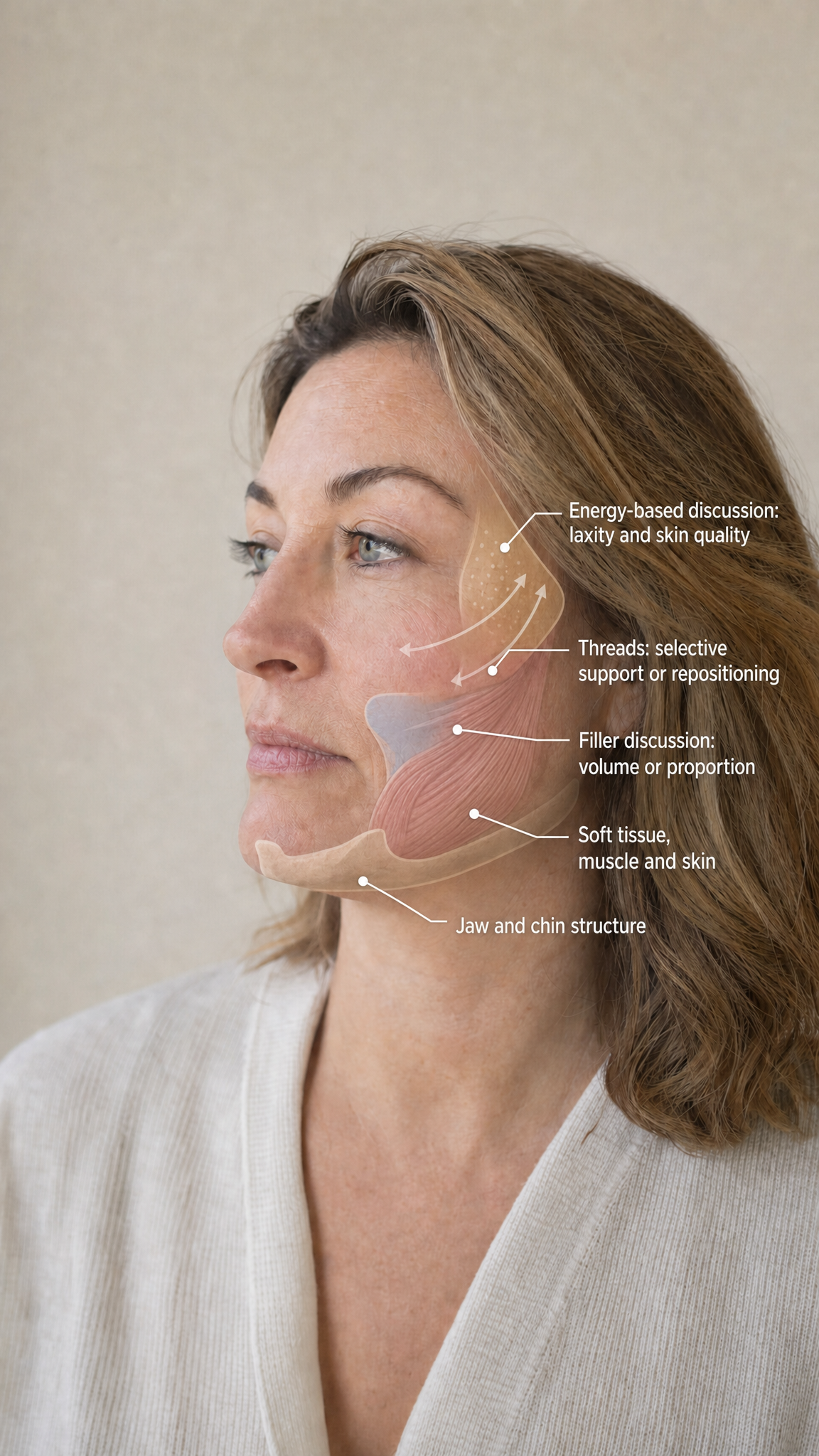
The lower face is not defined by skin alone. Its outline reflects the jaw and chin, fat, muscles, supporting structures and the skin covering them. A softer jawline or jowling can reflect overlapping changes in facial bone, fat position or volume, muscle activity and skin quality. The balance of these factors differs between people.
Age-related remodelling of the jaw and chin can contribute to changes in lower-face support and contour. This is one reason a lower-face concern should not automatically be treated as a skin-only or volume-only issue.
- A visible concern can have several anatomical contributors.
- A softer jawline does not automatically point to one treatment category.
Evidence note: Evidence on facial ageing describes changes across the bony platform, soft tissue, muscles and skin, rather than a single cause of lower-face change. N1
Why assessment differs
One concern, different contributors
Visible lower-face change cannot responsibly be matched to one default non-surgical option. A whole-face assessment matters. It should consider proportions, skin quality, movement, soft-tissue volume, jaw and chin structure, medical and dental history, previous procedures, and the degree of laxity before deciding whether any intervention is appropriate.
A consultation is particularly important where there is marked laxity, a heavy lower face, substantial asymmetry, prior filler or thread placement, scarring, previous facial surgery, dental or bite concerns, or an expectation that a non-surgical procedure can recreate surgical change.
- Assessment considers the whole face, not the jawline in isolation.
- History, structure and the degree of laxity can change what is appropriate to discuss.
Evidence note: Layered facial assessment and realistic expectations are important because anatomy, previous treatment and baseline laxity can materially affect an individual discussion. N1 N2 N7 N8

Mechanism matters
Different discussions, different limits
Facial contouring is an umbrella consultation topic rather than one fixed procedure. Where local volume or proportion is genuinely contributing, a clinician may discuss filler-based support or contour adjustment. Added volume does not recreate every element of skin tightening, tissue repositioning or skeletal support.
Threads may be considered selectively where modest support or repositioning is being discussed rather than adding fullness alone. They are procedures with their own recovery and complication profile, and should not be represented as a substitute for surgery when laxity is substantial.
Energy-based tightening may be discussed when mild-to-moderate laxity is a meaningful contributor to lower-face softness. Microfocused ultrasound uses focused thermal energy; the intended change is gradual and does not replace lost volume or produce a surgical lift.
The clinic describes Focus Dual as combining HIFU and RF microneedling. For this episode, it can be described as a clinic-offered technology that may be discussed for skin quality and laxity after assessment, not as a solution for every cause of lower-face definition loss.
- Volume, support and skin laxity are not interchangeable treatment targets.
- A named technology does not address every cause of reduced definition.
Evidence note: Available evidence and clinic context support mechanism-level discussion, with clear boundaries between volume adjustment, selective thread use and energy-based treatment for mild-to-moderate laxity. N1 N3 N6 N7 N8 N10
Realistic boundaries
What each approach cannot do
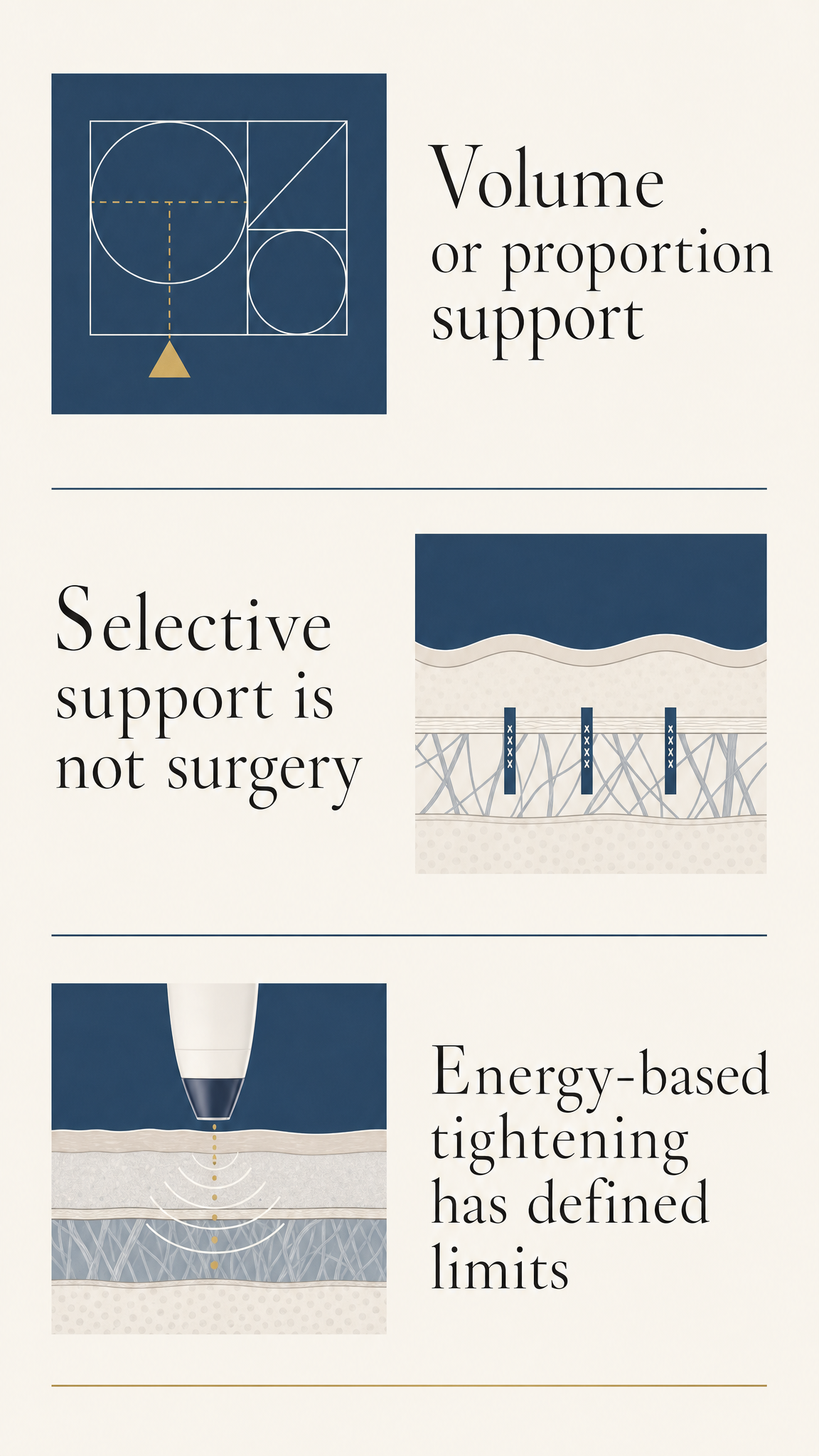
Filler-based contour adjustment may be discussed where volume or proportion is genuinely contributing, but added volume does not recreate every element of skin tightening, tissue repositioning or skeletal support.
Threads may be considered selectively for modest support or repositioning rather than adding fullness alone. They have their own recovery and complication profile and should not be represented as a substitute for surgery when laxity is substantial.
Focused ultrasound uses focused thermal energy when mild-to-moderate laxity is a meaningful contributor. Its intended change is gradual, does not replace lost volume and does not produce a surgical lift. Focused-ultrasound improvement can be modest and is less favourable with greater laxity. Pain and temporary redness or swelling can occur. It should not be presented as equivalent to a surgical lift.
Do not claim a fixed duration, guaranteed collagen response or predictable jawline change for Focus Dual. Results and recovery may vary with the component devices, settings, treatment area, baseline laxity, skin characteristics and protocol.
- Modest support, volume adjustment and skin tightening describe different aims.
- Greater laxity changes the limits of focused-ultrasound discussion.
Evidence note: Procedure discussions need to distinguish mechanism from outcome. Focused-ultrasound studies report modest improvement and variable protocols; evidence retained for Focus Dual does not establish fixed duration or predictable change. N3 N6 N7 N8 N10
Safety and restraint
Risks need their own discussion
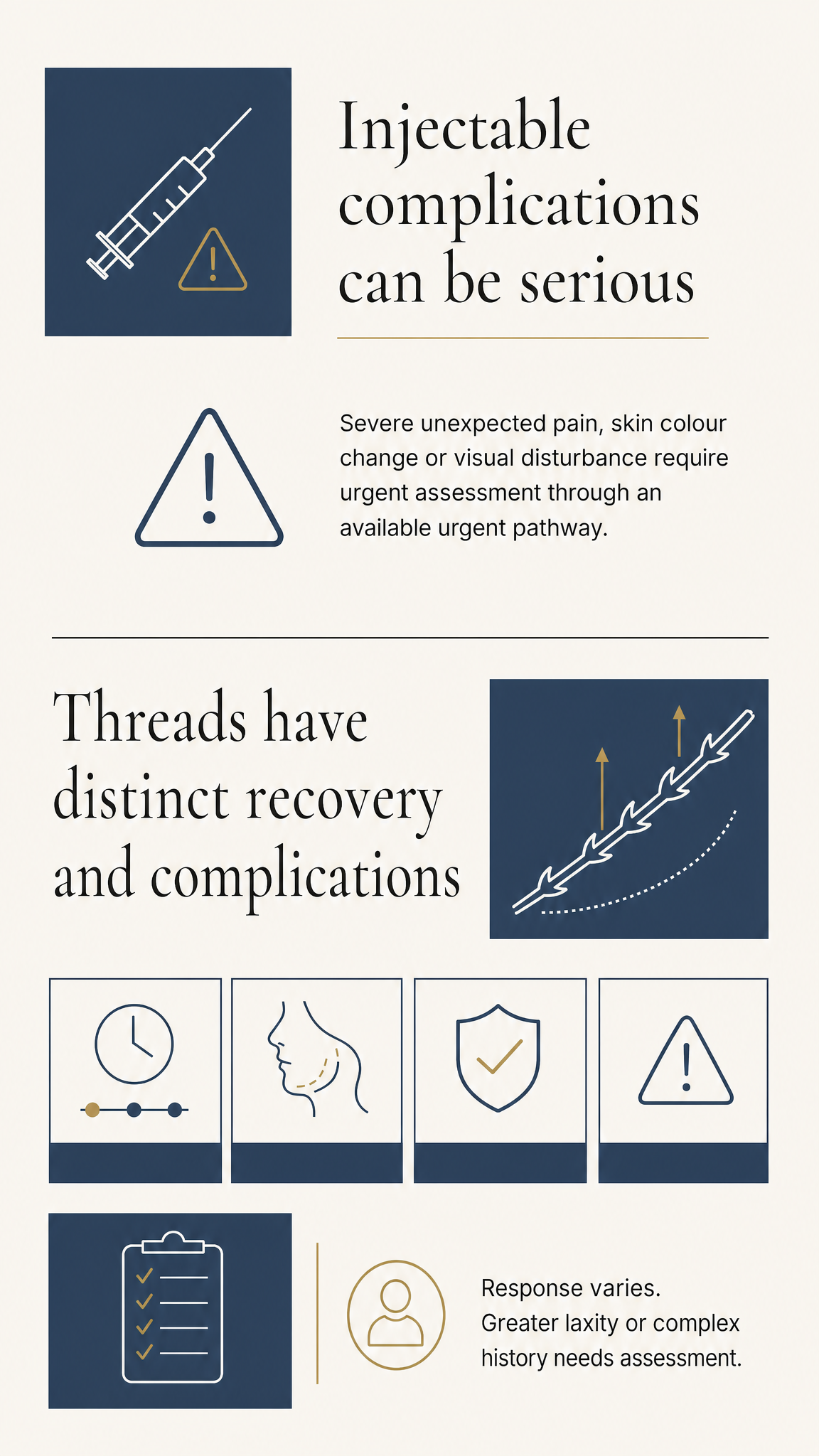
Dermal filler is an injectable procedure. Swelling, bruising and tenderness can occur. Rarely, filler can compromise blood flow, which may cause serious tissue injury and can require urgent management.
Any patient discussion of injectable contouring should include the possibility of urgent complications, how to recognise concerning symptoms such as unexpected severe pain, skin colour change or visual disturbance, and what urgent pathway is available.
Thread lifting can involve swelling, bruising, pain, dimpling or asymmetry, altered sensation, visible or palpable threads, infection and thread extrusion. The frequency of complications varies across studies, thread types and techniques.
No single non-surgical option addresses every contributor to lower-face change. Filler-based contour adjustment, threads and energy-based treatments act on different aspects of the problem, and none should be framed as guaranteed, permanent or universally suitable.
A consultation is particularly important where there is marked laxity, a heavy lower face, substantial asymmetry, prior filler or thread placement, scarring, previous facial surgery, dental or bite concerns, or an expectation that a non-surgical procedure can recreate surgical change.
- Injectable complications can be serious and may need urgent management.
- Thread-related complications and their frequency vary across studies, thread types and techniques.
- Complex history or marked laxity warrants individual assessment.
Evidence note: Risks should be explained by procedure type. Injectable contouring requires discussion of urgent complications and an urgent pathway; thread complication frequencies vary across studies, thread types and techniques. N1 N5 N7 N8
Making an informed decision
Assessment before selection
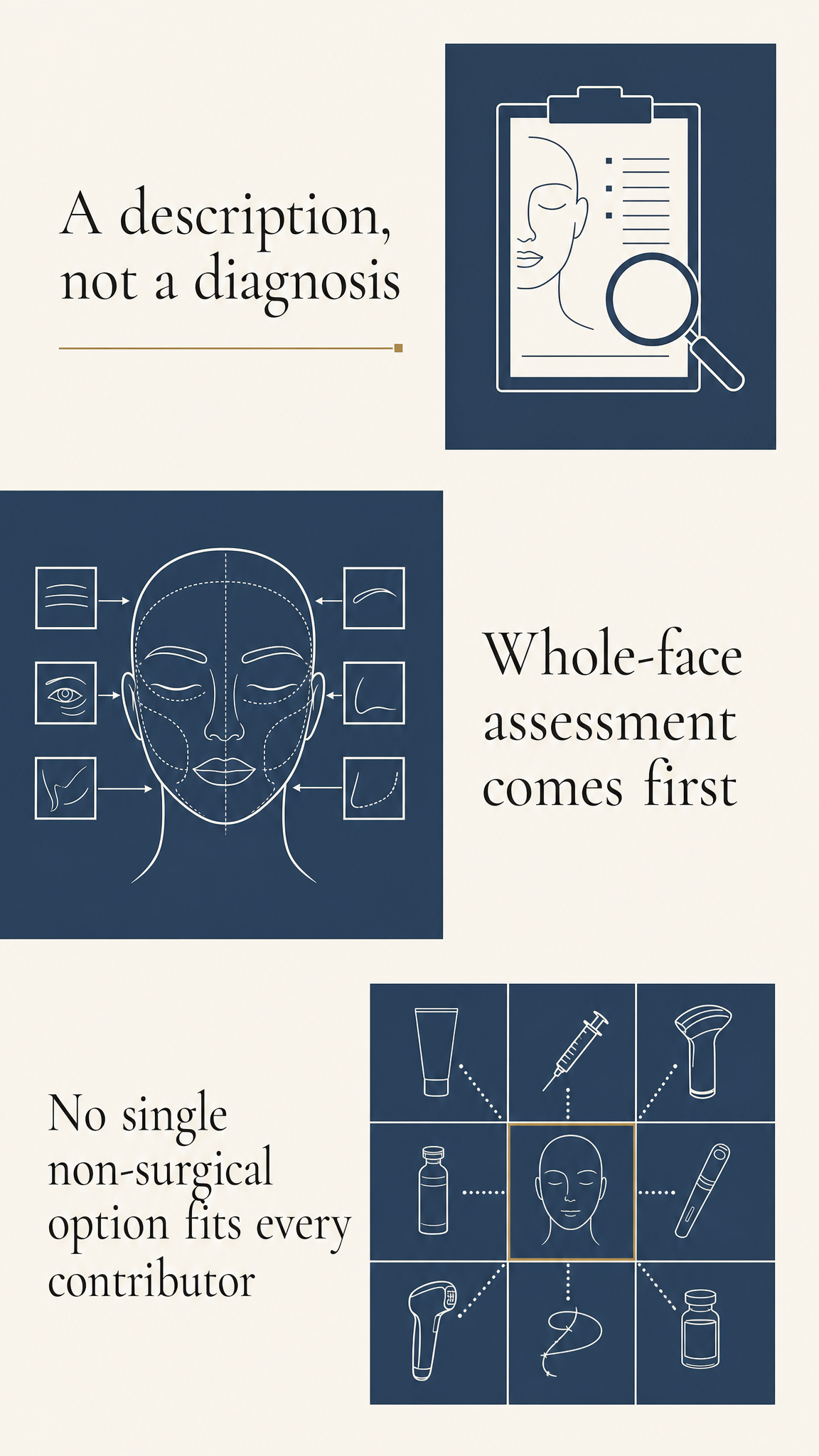
Loss of definition is descriptive, not diagnostic. It may reflect a less distinct jawline, altered chin-to-jaw proportion, skin laxity, local volume change, tissue descent, or a combination. Whole-face assessment considers proportions, skin quality, movement, soft-tissue volume, jaw and chin structure, medical and dental history, previous procedures, and the degree of laxity before deciding whether any intervention is appropriate.
No single non-surgical option addresses every contributor to lower-face change. Filler-based contour adjustment, threads and energy-based treatments act on different aspects of the problem, and none should be framed as guaranteed, permanent or universally suitable.
Public education should lead to a consultation or enquiry, not self-selection for a named procedure. A personalised discussion should cover the likely anatomical contributors, alternatives, expected degree of change, recovery, risks, costs and the possibility that no procedure is appropriate.
- A lower-face concern deserves a layered, individual assessment.
- The appropriate conclusion can be that no procedure is appropriate.
Evidence note: Education can clarify the questions to discuss, but it cannot determine suitability. A personalised consultation considers contributors, alternatives, limits, recovery, risks, costs and whether no procedure is appropriate. N1 N2 N3 N6 N9 N10
Sources and references
Evidence and guidance
- The Facial Aging Process From the "Inside Out", Aesthetic Surgery Journal / PubMed
- Facial Contouring, Dr Souphi Aesthetics and Wellbeing
- Dermal Fillers, Dr Souphi Aesthetics and Wellbeing
- Loss of Volume, Dr Souphi Aesthetics and Wellbeing
- Guideline for the Management of Hyaluronic Acid Filler-induced Vascular Occlusion, Journal of Clinical and Aesthetic Dermatology / PMC
- Threads and Thread-Lifting Procedures, Dr Souphi Aesthetics and Wellbeing
- A Meta-Analysis and Systematic Review of the Incidences of Complications Following Facial Thread-Lifting, Aesthetic Plastic Surgery / PubMed
- A Systematic Review of the Efficacy of Microfocused Ultrasound for Facial Skin Tightening, International Journal of Environmental Research and Public Health / PubMed
- Skin Tightening, Dr Souphi Aesthetics and Wellbeing
- Focus Dual, Dr Souphi Aesthetics and Wellbeing
Treatments that may be relevant
Explore information about treatments that may be discussed after an individual assessment.
-
Dermal Fillers
Explore treatment -
Facial Contouring
Explore treatment -
Threads and Thread-Lifting Procedures
Explore treatment -
Focus Dual
Explore treatment -
Skin Tightening
Explore treatment

Ready for a more considered consultation?
A consultation can help determine what is relevant to you.