Journal
Not all lines are the same
Facial lines can reflect repeated movement, skin-surface change, and changes in support or volume. These influences may overlap, so a line seen in one area does not automatically have one cause or one universal answer.

What the evidence can and cannot tell us
Facial lines can have overlapping drivers
Skin, soft tissues and deeper structures all contribute to facial appearance. Movement-related lines and lines present at rest may have different drivers.
Evidence differs by option and outcome
Movement-focused injectable trials varied in dose, treatment area and outcome measures. Injectable hyaluronic-acid skin-quality studies also used differing formulations and methods.
Results and safety need individual context
Skin-quality evidence is promising but larger randomised trials are still needed. Injectable procedures are clinical interventions with risks; outcomes and longevity vary; and individual assessment is required.
Understanding lines
A line can have more than one driver
Not all facial lines have the same cause. Repeated movement, skin-surface change, and changes in facial support or volume can all contribute, sometimes together.
The face is not a flat surface: skin sits over soft tissues and deeper structures. A line that appears mainly when you move may have a different driver from one that remains at rest.
Over time, skin elasticity, subcutaneous fullness and underlying bone can change. These changes do not occur at the same rate, or in the same pattern, for every person.
- Movement, surface change and support or volume can overlap.
- Lines that appear with movement may differ from lines visible at rest.
Evidence note: Facial ageing is understood as a three-dimensional process involving skin, soft tissues and deeper structures. Individual patterns of change vary. E01
Individual variation
Appearance alone cannot choose an option
The useful consultation question is not simply “Which treatment is best?” but “What is making this line visible here?” Assessment should consider movement, skin-surface change, support or volume change, medical history, previous procedures, anatomy, priorities and tolerance for uncertainty, risk and downtime.
One option may address one component of a concern without addressing the others. Depending on assessment, the appropriate plan may be skincare first, no procedure, or a staged approach rather than a single intervention.
- A visible line does not identify its cause on its own.
- A plan may be skincare first, no procedure or staged.
Evidence note: Assessment considers the possible contributors to a concern, alongside history, anatomy, priorities and tolerance for uncertainty, risk and downtime. E01 E05 X04 E04 E12

Different mechanisms
Options are designed for different components
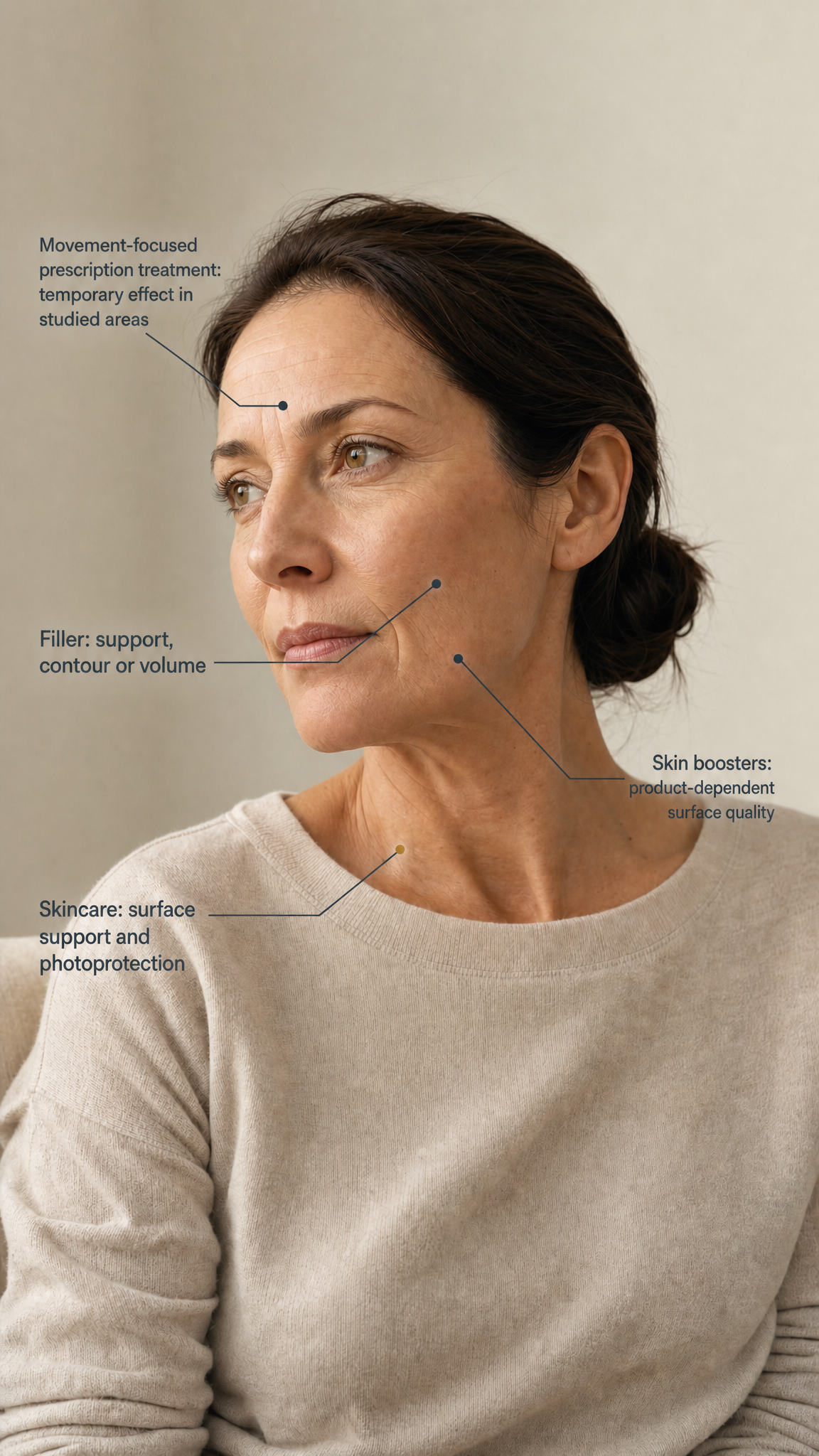
For lines driven chiefly by selected muscle movement, a clinician may discuss a prescription-only botulinum-toxin treatment. Evidence shows a temporary reduction in wrinkle severity in studied facial areas; it is not a treatment for replacing lost volume or rebuilding all aspects of skin structure.
A movement-focused injectable is not a universal answer to every line. Published trials differed in dose, injection area and outcome measures; effects were temporary, and adverse effects including eyelid droop were reported in studies of glabellar lines.
Dermal filler is a different tool from a movement-focused injectable. It places material in selected tissue planes to alter local support, contour or volume; it does not selectively reduce muscle movement.
“Skin booster” is a broad, product-dependent term. The clinic describes this option as targeting hydration, softness and surface quality rather than structural change. Evidence for injectable hyaluronic-acid formulations concerns skin-quality measures such as hydration, texture, radiance, firmness and elasticity.
Evidence for injectable hyaluronic-acid skin-quality treatments is promising, but it is not definitive. Formulations, combinations and study methods vary, and larger randomised trials are still needed; a result cannot be assumed from the category name alone.
Skin boosters remain injection procedures. Redness, swelling, bruising and tenderness may occur, and the same consultation should cover product-specific risks, anatomy, technique and what to do if there is a complication.
A clinically selected home-skincare plan can support barrier care, address some surface concerns and include photoprotection. It is not equivalent to an injectable treatment: skincare cannot replace lost volume or selectively reduce muscle activity. Skincare must be specific to the concern and tolerated by the individual. Some active ingredients can irritate; retinoids, for example, can be unsuitable in pregnancy and may aggravate dryness, redness or inflammation. A product plan should not be presented as universal.
Public education may discuss the clinical category of prescription-only botulinum-toxin treatment neutrally, but must not name or advertise a prescription-only medicine to the general public. Public calls to action should lead to consultation, enquiry or editorial education rather than a named prescription-medicine offer.
Where a clinic treatment page is referenced in this episode, use it only as contextual evidence of the service offered. Do not use clinic copy alone as proof of efficacy, safety, collagen stimulation, fixed duration, prevention or suitability.
- Movement, support or volume, surface quality and barrier care are different clinical contexts.
- Skin-quality evidence is promising, but not definitive.
Evidence note: Evidence and expected effects differ between movement-focused treatment, filler, injectable skin-quality treatments and skincare. Category names alone do not determine an individual result. E04 E05 E06 E08 E12 E13 E16 E17 X04 X07 X08 X13 X14
Assessment
Suitability is not a menu choice
Whether filler is appropriate depends on the individual area, anatomy, skin and scar tissue, prior procedures or surgery, goals and risk tolerance. It should not be described as a routine beauty add-on or as risk-free.
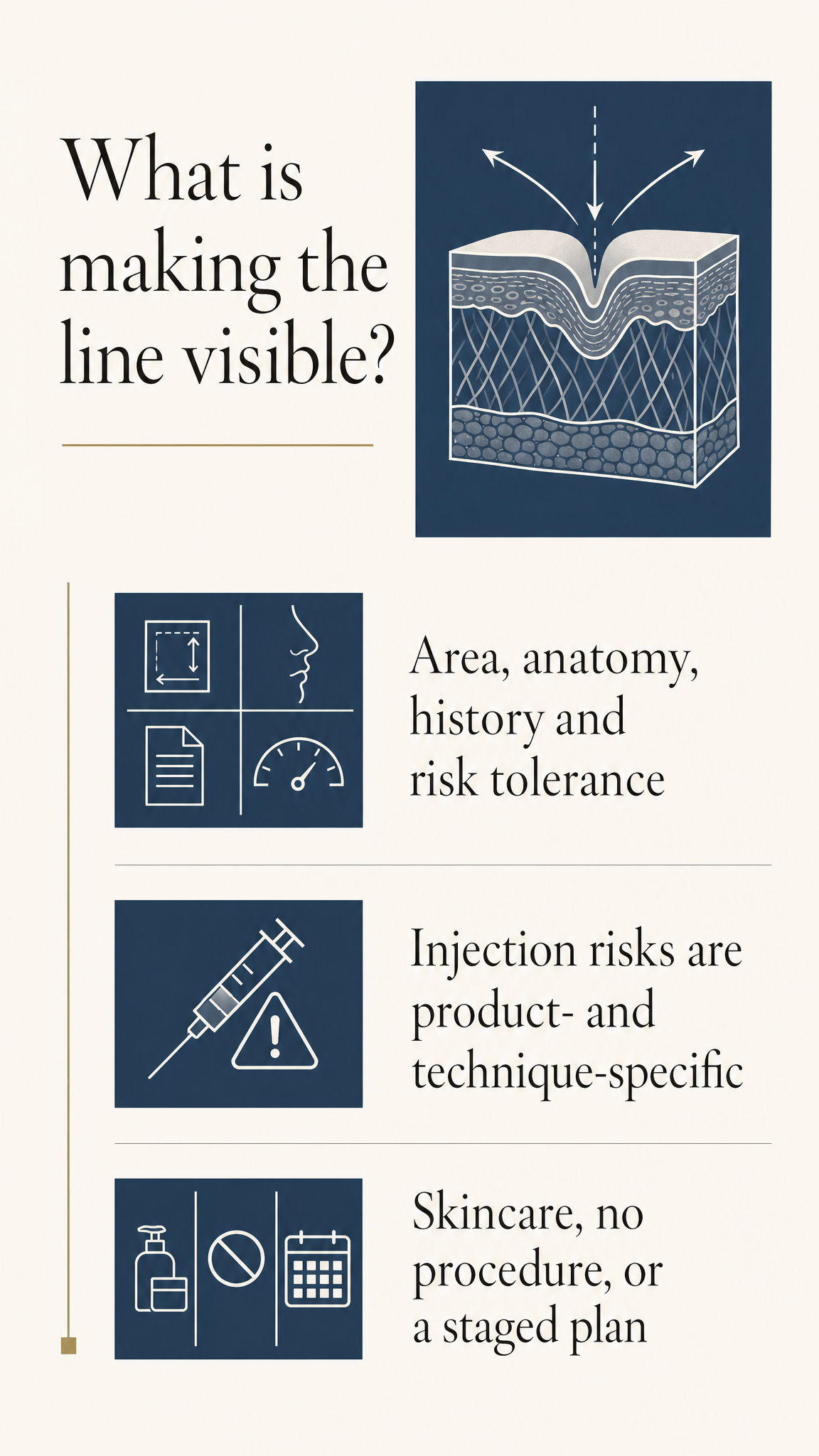
The useful consultation question is not simply “Which treatment is best?” but “What is making this line visible here?” Assessment should consider movement, skin-surface change, support or volume change, medical history, previous procedures, anatomy, priorities and tolerance for uncertainty, risk and downtime.
One option may address one component of a concern without addressing the others. Depending on assessment, the appropriate plan may be skincare first, no procedure, or a staged approach rather than a single intervention.
- Area, anatomy, skin, history and goals all matter.
- Risk tolerance and uncertainty are part of an individual assessment.
Evidence note: Suitability depends on the individual concern and context. An appropriate plan does not have to involve a procedure. E01 E04 E05 E12 E08 X04 X08
Clinical restraint
Injectable procedures carry meaningful risks
Filler is an injection procedure with meaningful risks. Bruising, swelling, infection and lumps can occur. Rarely, vascular compromise can lead to tissue injury, and visual or neurological harm is possible; clinicians need clear recognition, escalation and emergency-management pathways.
Use balanced language: injectable procedures are clinical interventions with risks; outcomes and longevity vary; and individual assessment is required. Do not trivialise procedures, promise a visible result or imply that age-related change requires correction.
- Filler risks include bruising, swelling, infection and lumps.
- Rare vascular compromise can cause tissue injury, visual harm or neurological harm.
Evidence note: Injectable procedures are clinical interventions. Risk recognition, escalation and emergency-management pathways are important components of safe practice. E08 E16 X04 X08

Informed perspective
Start with why the line is visible
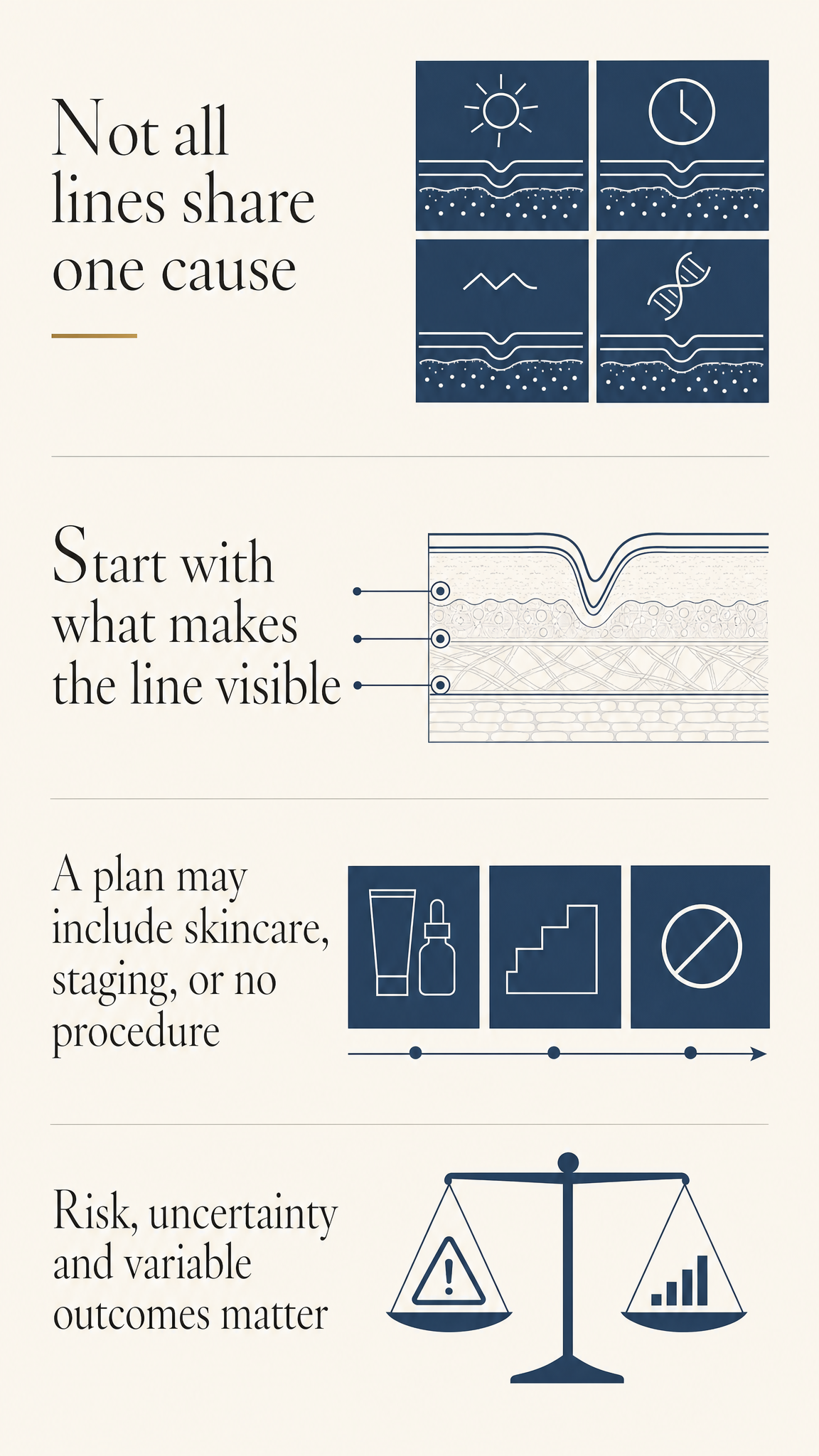
Not all lines share one cause. The useful consultation question is not simply “Which treatment is best?” but “What is making this line visible here?” Assessment should consider movement, skin-surface change, support or volume change, medical history, previous procedures, anatomy, priorities and tolerance for uncertainty, risk and downtime.
One option may address one component of a concern without addressing the others. Depending on assessment, the appropriate plan may be skincare first, no procedure, or a staged approach rather than a single intervention.
- Start with the possible drivers of the line in that area.
- A clinically appropriate plan may include skincare, staging or no procedure.
Evidence note: There is no universal best option for every facial line. Individual assessment helps place appearance, uncertainty, risk and downtime in context. E01 E04 E05 E12 X04
Sources and references
Evidence and guidance
- The anatomy of the aging face: volume loss and changes in 3-dimensional topography, Aesthetic Surgery Journal / PubMed
- Skin Boosters, Dr Souphi
- Wrinkle Reduction Injections, Dr Souphi
- Facial aesthetics: is botulinum toxin treatment effective and safe? A systematic review of randomised controlled trials, Cochrane Database of Systematic Reviews / PubMed
- Guideline for the Management of Hyaluronic Acid Filler-induced Vascular Occlusion, Journal of Clinical and Aesthetic Dermatology / PMC
- Medical Grade Skincare, Dr Souphi
- Sunlight exposure: risks and benefits, National Institute for Health and Care Excellence
- Advertise your medicines, Medicines and Healthcare products Regulatory Agency / GOV.UK
- Botulinum toxin type A products: updated warnings regarding risk of iatrogenic botulism, Medicines and Healthcare products Regulatory Agency / GOV.UK
- Dermal Fillers, Dr Souphi
- The Effectiveness of Injectable Hyaluronic Acid in the Improvement of the Facial Skin Quality: A Systematic Review, Clinical, Cosmetic and Investigational Dermatology / PubMed
- Treatment of Soft Tissue Filler Complications: Expert Consensus Recommendations, Aesthetic Plastic Surgery / PubMed
- Retinoid or retinol?, American Academy of Dermatology
- Acne: Diagnosis and treatment, American Academy of Dermatology
Treatments that may be relevant
Explore information about treatments that may be discussed after an individual assessment.
-
Dermal Fillers
Explore treatment -
Wrinkle Reduction Injections
Explore treatment -
Skin Boosters
Explore treatment -
Medical Grade Skincare
Explore treatment

Ready for a more considered consultation?
A consultation can help determine what is relevant to you.